
Most roofing owners answer a slow month by buying more leads. Here are 15 places revenue leaks out of a roofing business, and how to check each one yourself.
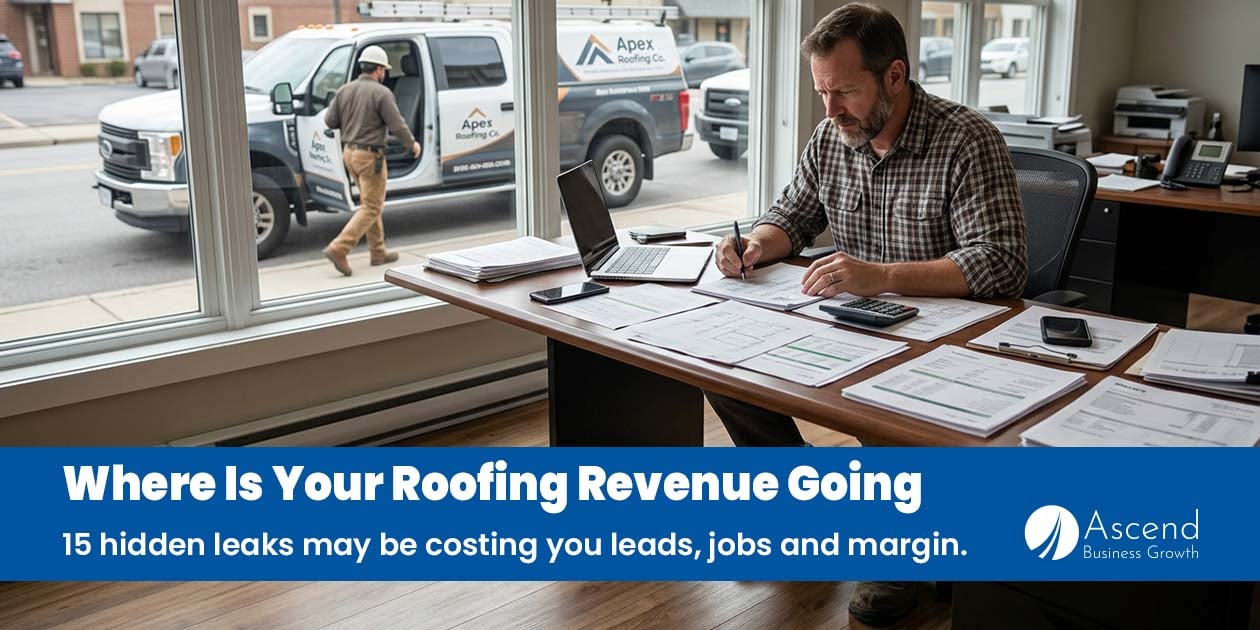
Most roofing owners respond to a slow month by buying more leads. It's the obvious move, and it's usually the expensive one.
The leads you already generate cost you money to get. Somebody answered the phone, drove out, climbed on the roof, measured it, and wrote a number. All of that is spent whether the job closes or not. When one of those opportunities quietly disappears — a number that doesn't ring, an estimate nobody followed up on, a homeowner who never heard back — you don't just lose the job. You lose everything you spent getting to it.
That's a revenue leak. And unlike more advertising, plugging one costs almost nothing and adds margin directly.
Every roofing company has revenue leaking somewhere between the phone ringing and the job getting sold. Finding those leaks is the only way to grow without spending more. The work is already sitting there. Most owners just can't see where it's going.
This guide covers 15 of them, grouped by where they happen in your process. Each one has its own article with a 10-minute self-check you can run without calling anybody.
Table of Contents
- What is a revenue leak?
- Getting found: before a homeowner ever contacts you
- Getting the conversation: they reached out, now what?
- Winning the job
- Keeping the margin: the job is sold
- What the job produces next
- Seeing any of it
- Where to start
- Find your roofing revenue leaks
- Roofing revenue leak FAQs
What is a revenue leak?
A revenue leak is a place where an opportunity or a dollar of margin disappears without anybody noticing. That last part is what makes it different from an ordinary problem.
When a crew no-shows, you hear about it. When a customer is furious, you hear about it. When a supplier shorts a delivery, you hear about it within the hour.
Revenue leaks don't work that way. A homeowner who reached voicemail and called the next company doesn't file a complaint. An estimate that went cold in October doesn't send an alert. A marketing line that hasn't produced a job in a year keeps renewing quietly, because nothing in your business is set up to flag it.
So the business feels normal. It is normal — this is just how it's been.
These leaks come in two kinds, and the difference matters.
Before the sale, you lose opportunities. Homeowners who were ready to hire somebody and ended up hiring someone else. You paid to generate them either way.
After the sale, you lose margin. The job is yours. What leaks is the gap between what you priced and what it actually costs to deliver.
Almost every one of the fifteen below can be checked in about ten minutes, by you, without buying anything.
Getting found: before a homeowner ever contacts you
The first four leaks happen before you've met anybody. Nothing is lost, exactly — you just never had it.
1. Your search visibility
Owners tell me they want to "show up," then check by Googling their own company from their own office. That's the least reliable test available. Local results change block by block, and most roofing companies are strong in one town and invisible in the rest of their service area.
Self-check: search "roof repair near me" from another town you serve, in a private browser window.
Read the article: Roofing SEO Gaps That Cost You Local Organic Leads →
2. Your ad spend
Advertising doesn't create customers. It buys attempts. Whatever your business currently does with an opportunity, more spend makes it do more of that — including the losing. Which is why increasing the budget so often produces less than expected.
Self-check: click your own ad from a phone, then call the number in it on a Saturday.
Read the article: Why More Roofing Ads Can Mean More Wasted Money →
3. Your finished work
Every completed roof produces photos, a happy customer, a neighborhood that watched you work, and a story. All four are free, all four expire in about a week, and most roofing companies capture none of them. Nextdoor is the biggest single gap between solo roofers and companies with crews.
Self-check: look up your own Nextdoor page. You may have one you've never claimed.
Read the article: Why Most Roofing Social Media Doesn't Generate Business →
4. Your website
A homeowner has your site open next to two competitors. All three install roofs, all three have good reviews, and all three claim quality work. Your website's job is to make the next step obvious enough to win that comparison.
Self-check: open your site next to two competitors on your phone and pick which one you'd call.
Read the article: Why Your Roofing Website Doesn't Bring You Jobs →
Getting the conversation: they reached out, now what?
These three are the most expensive per dollar of marketing spend, because everything you spent to make that phone ring is already gone by the time it rings.
5. Your phone numbers
Most roofing companies have more phone numbers in circulation than they realize, each with its own forwarding rules set at a different time by a different person. Those rules break quietly. Nothing errors out. The phone just stops ringing in the right place, sometimes for weeks.
Self-check: call every number you own, from a phone the office doesn't recognize, on a Saturday.
Read the article: Call Routing Problems That Lose Roofing Jobs →
6. Your response time
Roofing is an urgency category. A homeowner with water coming in works down the list until somebody answers. And the people at your company qualified to respond are on roofs during exactly the hours leads arrive.
Self-check: submit your own form at 4 pm on a Friday and time how long until a human calls.
Read the article: Roofing Lead Response Time Wins or Loses the Job →
7. The leads who aren't ready yet
Most roofing companies have two places to put a lead: an estimate on the calendar or nothing. Everything that isn't ready today falls into nothing — including the homeowners who said "next spring, after bonus season" and meant it.
Self-check: ask a canvasser what happened to the maybes from a specific Saturday.
Read the article: Roofing Lead Qualification Gaps That Cost You Next Spring →
Winning the job
By this point, you've paid for the lead, the response, the drive, and the inspection. These two decide whether any of that turns into revenue.
8. Your sales process
Two estimators, same leads, same prices, wildly different close rates. Usually, the gap isn't talent — it's that your best estimator built a sales process in his own head over a decade, and nobody else has access to it.
Self-check: ask two estimators separately what they do after leaving a kitchen table, then compare.
Read the article: A Weak Roofing Sales Process Shows Up in Your Close Rate →
9. Your unsold estimates
Your pipeline can show 180 open estimates worth $2 million and tell you nothing about which ones are still alive. "Open" usually just means nobody marked it closed.
Self-check: find your oldest open estimate. Then count how many have had no contact in 30 days.
Read the article: Quote Follow-Up: Why Roofing Estimates Go Cold →
Keeping the margin: the job is sold
Here the arithmetic changes. You already won the work and already spent the money to get it. What leaks now is the difference between the margin you priced and the margin you keep.
10. The handoff to your crew
The estimator knew about the third layer. He wrote it down, priced it in, and the homeowner paid for it. That information just never made it to the truck, and now three guys are standing in a driveway waiting on a bigger dumpster.
Self-check: ask a crew lead what surprised him on a job this month.
Read the article: Why Your Roofing Sales Handoff Is Costing You Profit →
11. Your crew scheduling
Two crews pass each other on the highway, each headed to a job in the other's neighborhood, one of them to work they're slow at. The estimate didn't change. The invoice didn't change. The cost did.
Self-check: ask three crew leads what time they left the shop and what time the first shingle came off.
Read the article: Bad Roofing Crew Scheduling Eats the Margin You Priced →
12. Your materials and job costing
Materials are commonly 40% of a roofing job. Over-ordering, unreturned bundles, stock nobody tracks, and estimating templates that never got updated after the last price increase — none of it appears anywhere you'd notice.
Self-check: walk the yard and write down what's out there. Then compare your estimating costs to this week's supplier pricing.
Read the article: How Poor Roofing Job Costing Cuts Your Profit Margin →
What the job produces next
This is the only stage that creates new leads instead of consuming them.
13. Your close-out
Your customer isn't buying another roof for twenty-five years. Everything she's still worth to you is a review, a referral, a photo, and a neighborhood — and all four have a shelf life of about a week. The day the job finishes is the peak.
Self-check: count last month's reviews against last month's finished jobs.
Read the article: A Weak Close-Out Loses Roofing Reviews and Referrals →
Seeing any of it
The last two are about measurement, and they're the reason the other thirteen can run for years.
14. Your marketing attribution
You know how many leads came in. You know you sold eleven jobs. You can't say which of the eleven came from which invoice — so you can't cancel anything, because any line you cut might be the one that was working. The budget only grows.
Self-check: take your last 20 sold jobs and write down the source and how you know it.
Read the article: Bad Marketing Attribution Is Costing You Roofing Margin →
15. Nobody owning the numbers
Every leak above has a duration, and the duration is decided by how long it takes somebody to notice. A leak caught in a month costs a month. The same leak caught in a slow February costs two years.
Self-check: whose job is it to notice when something in this business stops working?
Read the article: Roofing KPIs Won't Help If Nobody Owns the Numbers →
Where to start
Not at the top. Start with the cheapest fixes, then move to the expensive ones.
Most of these cost nothing but attention. A few of them cost a decision. Almost none of them require buying software, which is worth saying because the usual response to "we can't see what's happening" is to go shopping.
A reasonable order for a company with a few crews:
- Call every number you own. Ten minutes, free, and it's the earliest leak in the process.
- Submit your own form on a Friday afternoon. You'll learn your real response time, which will be slower than you think.
- Find your oldest open estimate. This is usually the most uncomfortable one and the most valuable.
- Walk the yard and check your estimating prices. Pure margin, sitting in plain sight.
- Put one hour a month on somebody's calendar. Without this, everything above comes back.
Notice what isn't on that list: buying more leads. That's the most expensive lever available, and it works best last, into a process that converts.
Find your roofing revenue leaks
You may not need more leads. You may need to find out what's happening to the ones you already have.
The free Roofing Revenue Leak Check is one outside pass across your lead-to-revenue process — from how homeowners find and contact you through response, appointments, estimates, follow-up, sales, and measurement.
We start with one short call. Then I look at what's public and, where it helps, what's happening inside your process. You get a plain-English list of what may be leaking, roughly what it may be costing you, and what I'd fix first. If nothing's leaking, you'll know that for certain instead of guessing. No pitch buried inside it.
Check your roofing revenue leaks →
Roofing revenue leak FAQs
What is a revenue leak in a roofing business?
A revenue leak is a place where an opportunity or a dollar of margin disappears without anybody noticing. Before the sale, you lose homeowners who were ready to hire somebody and hired a competitor instead. After the sale, you lose the difference between what you priced a job at and what it actually cost to deliver. What they share is silence — nothing errors out, and nobody complains.
Why shouldn't I just buy more roofing leads?
You can, and it's the fastest lever available. It's also the most expensive, and it multiplies whatever your process currently does with an opportunity. If a quarter of your leads die somewhere inside your business, then a quarter of every new advertising dollar buys nothing. Fixing the free gaps first makes every dollar you spend afterward go further.
Which roofing revenue leak should I check first?
Your phone numbers. It takes about ten minutes, costs nothing, and it's the earliest point in the process — everything you spent to make the phone ring is already gone by the time it rings. Call every number you have in circulation from a phone your office won't recognize, once during the day and once on a weekend.
Do I need new software to fix these?
Mostly no. Most of these are decisions rather than tools: who owns the hour, what gets written down, which questions get asked on a schedule. Software becomes worth buying when the manual version becomes the bottleneck, which usually happens somewhere past four crews. Buying a system before anyone owns the numbers tends to produce the same blind spots plus a subscription.
How much do roofing revenue leaks actually cost?
It depends entirely on your volume, which is why every article in this series shows you how to run the arithmetic on your own numbers rather than quoting a benchmark. The pattern worth understanding is that the cost of a leak is mostly its duration. A problem caught in a week is a nuisance. The same problem caught eighteen months later is a season of work you never knew you lost.


Comments