
Two crews passing each other on the highway, each headed to a job in the other's neighborhood. Here's what roofing crew scheduling costs when nobody's managing it.
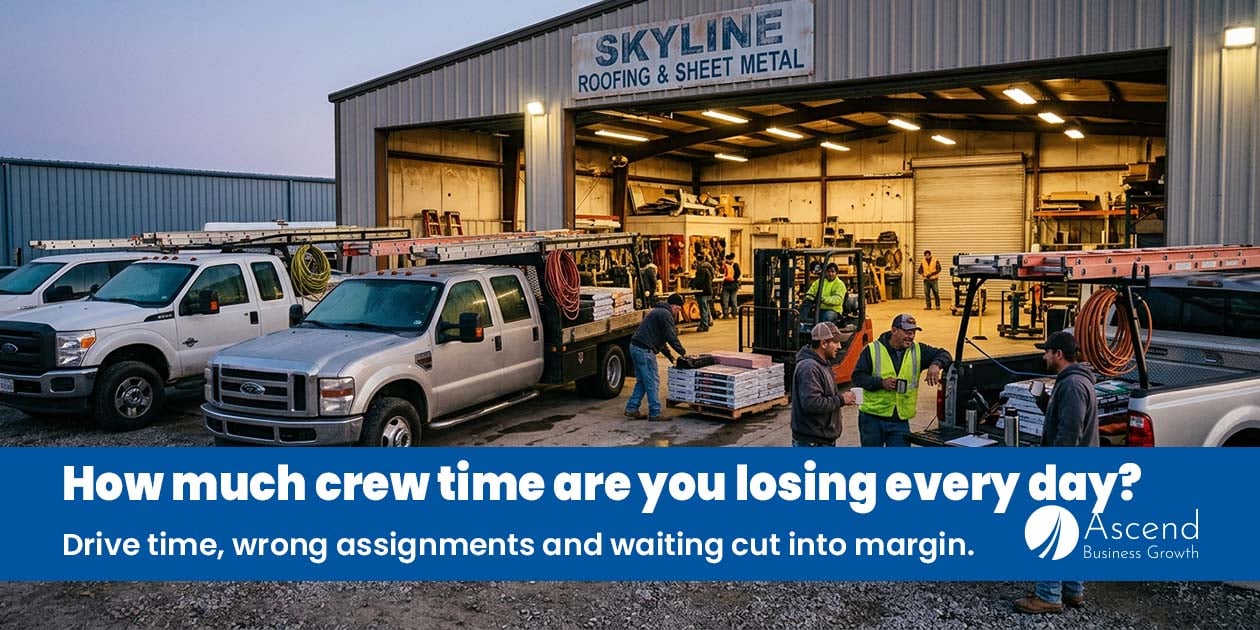
Two crews leave the shop on a Tuesday morning. One drives thirty-five minutes north. The other drives forty minutes south.
The job to the north is a steep cut-up roof with three valleys, and the crew heading there mostly does simple ranches. The job to the south is a straightforward tear-off that the other crew could have knocked out by early afternoon.
Both jobs get done. Both crews work hard. Nobody complains.
And somewhere between the drive time and the mismatch, most of a crew day disappeared.
That's a revenue leak, and like the sales handoff, it comes out of margin rather than out of your lead flow. These are jobs you already sold at prices you already set.
What's missing is intelligent scheduling — getting the right crew to the right job at the right time, where "right" accounts for skill, distance, crew size, weather, and whether the materials actually arrived.
Here's the size of it. A crew of four costs roughly $150 an hour all in. If poor sequencing costs each crew ninety minutes of productive time a day, that's about $225 a day, per crew, every day you operate.
This article covers what scheduling is really deciding, why roofing is harder to schedule than most trades, what the lost hours cost, and how to check your own utilization.
Table of Contents
- Key takeaways
- What is your scheduling actually deciding?
- Why roofing is harder to schedule than most trades
- Right crew: skill and size matter more than availability
- Right time: weather, materials, and the cascade
- When sales promise a date operations can't hit
- The customer's day is part of your schedule
- What does poor roofing crew scheduling cost?
- How to check your own scheduling
- What does good roofing crew scheduling look like?
- How does scheduling fit into the bigger revenue picture?
- Find your roofing revenue leaks
- Roofing crew scheduling FAQs
Key takeaways
- Scheduling looks like a calendar problem and is really a margin problem. Every assignment has money attached to it.
- Availability is the weakest way to assign a crew. Skill, crew size, and drive time all cost more than whoever happens to be free.
- Weather makes roofing schedules cascade, so the real question isn't the plan — it's how fast you can rebuild it.
- Sales often promise start dates without knowing real production capacity, which turns a scheduling problem into a customer problem.
- Crew utilization is the single most useful number that most roofing companies don't track.
What is your scheduling actually deciding?
Every scheduling decision sets the actual cost of a job you already priced.
That's the part that gets missed. Scheduling feels administrative — names on a calendar, jobs in a sequence, something the office handles. But the calendar is where your gross margin gets finalized.
Consider what one assignment determines. How long the crew drives before they start earning. Whether they're doing work they're fast at or work they're slow at. Whether there are enough of them to finish today or just enough to need a second day. Whether the materials are there when they arrive. Whether the customer is expecting them.
Price the job at 30% margin, then schedule it badly, and you delivered it at 18%. The estimate didn't change. The invoice didn't change. The cost did.
And it's invisible in your accounting, because labor gets recorded as labor whether it was productive or spent in a truck.
Why roofing is harder to schedule than most trades
Roofing has more variables that move than almost any other residential trade, and several of them move without warning.
An electrician's Tuesday looks fairly similar in April and August. A roofer's doesn't.
The weather governs everything. You can't tear off ahead of rain. A wet week doesn't just delay jobs; it compresses the next dry week into something nobody can staff.
Jobs vary enormously. A 12-square walkable ranch and a 40-square cut-up with three valleys are the same line item on a schedule and completely different days.
Crew capability varies. Steep pitch, metal, tile, slate, complex flashing — not every crew does everything well, and the difference shows up in hours.
Material and dumpster timing have to line up. Shingles in the driveway the day before is good. Shingles arriving at 10 am while the crew waits is expensive.
Insurance work has its own clock. Approvals and supplements land when they land, and a job can go from "someday" to "we need to start Thursday" without notice.
Storms rewrite the whole board. Demand triples in a week, and every scheduling weakness you had becomes expensive at once.
So a roofing schedule isn't a plan you execute. It's a plan you rebuild constantly, and how fast you can rebuild it is the actual capability.
Right crew: skill and size matter more than availability
Most roofing companies assign crews based on who's free, which is the least informative thing you know about them.
Three factors beat availability, and all three have direct costs:
Skill match. A crew that does steep cut-up roofs every week finishes one in a day. A crew that mostly does walkable ranches might take a day and a half and produce work that needs a return visit. Same job, same price, different cost.
Crew size against job size. Three guys on a 40-square job means two days when it should have been one. Six guys on a 12-square job means four of them go home at noon. Both waste money in opposite directions, and both look fine on a calendar.
Distance. Drive time is paid time that produces nothing. A crew working twenty minutes away gets most of a day on the roof. A crew working fifty minutes away loses nearly two hours before anybody earns anything, and it happens again going home.
The fix isn't complicated in principle. Group jobs geographically when you can. Know which crew is fast at what. Match headcount to square count.
What makes it hard is that nobody can hold all of it in their head while the phone is ringing, and it's about to rain on Thursday.
Right time: weather, materials, and the cascade
A roofing schedule's real test isn't the plan on Monday. It's what happens when it rains on Tuesday.
Here's the cascade. Rain on Tuesday means Tuesday's tear-off moves to Wednesday. Wednesday's job moves to Thursday. Thursday's crew was already committed Friday. The material delivery for Wednesday's job is now sitting at a house nobody's working on. The dumpster is in the wrong driveway. And three customers are waiting for a phone call nobody made.
One rain day, handled well, costs you a day. Handled badly, it costs most of a week, because every downstream piece has to be renegotiated by phone.
Two things separate companies that recover quickly from those that don't.
Slack in the schedule. A schedule booked to 100% has nowhere to absorb a rain day. Booking to roughly 85% feels like leaving money on the table and is usually cheaper than the alternative.
One place everyone looks. When the schedule lives in a shared, current view, rebuilding it is a morning's work. When it lives across a whiteboard, three text threads, and the owner's memory, rebuilding it means a dozen phone calls and a few things falling through.
Materials deserve their own note here. Delivery timing should be tied to the job's actual date, not to the date it was ordered for. When the schedule moves and the delivery doesn't, you've created a second problem out of the first one — and material sitting in the wrong driveway is how it ends up charged to the wrong job.
When sales promise a date operations can't hit
A lot of scheduling problems start at the kitchen table, weeks before anyone looks at a calendar.
A homeowner asks when you could start. The estimator, wanting to close, says two weeks. He doesn't actually know what the next two weeks look like — he's been in trucks and on roofs, not in the schedule.
Production finds out about that promise when the signed contract lands.
Now there are only bad options. Squeeze it in and disrupt three other jobs. Call the customer and walk back the date, starting the relationship with a broken promise. Or let it slide and hope nobody notices, which is how homeowners end up waiting in empty driveways.
This is a solvable problem, and it's rarely treated as one. The estimator needs to know, at the kitchen table, roughly when the next real opening is. Not a guess — a number that reflects actual committed work. It belongs in the same set of materials he takes to every estimate.
For a small company, that can be a single shared calendar he can glance at from his phone. For a bigger one, it means sales and production looking at the same capacity picture instead of two different ones.
Either way, the principle is the same: a start date is a promise, and promises made without information become customer problems later.
The customer's day is part of your schedule
Every scheduled job has a homeowner arranging their life around it, and they're usually the last to hear when something moves.
Someone took a day off work. Boarded the dog. Moved cars out of the driveway. Told the neighbors there'd be noise.
When the schedule shifts, the crews find out, the office finds out, and the customer discovers it by waiting.
The operational cost of that is small. The relationship cost isn't. A delay explained in advance is weather, and everyone understands weather. A delay discovered in an empty driveway is unreliability, and that's what gets told to coworkers and left in reviews.
This is the cheapest thing in this entire article to fix. When a job moves, somebody calls or texts the homeowner the same day. That's it. No system required — though the reason it doesn't happen is almost always that nobody owns it, and in a busy week, it's the first thing dropped.
What does poor roofing crew scheduling cost?
It comes out of crew utilization, which is the most expensive number in your business and the one least likely to be measured.
These are illustrative numbers. Use your own.
Say a crew of four costs you about $150 an hour, all in. On a good day, they get seven productive hours on a roof. On an average day — long drive, wrong materials, waiting on a dumpster, a job that needed a different crew — they get five and a half.
That's ninety minutes a day, or about $225 per crew.
Across three crews over roughly 220 working days, that's around $148,000 a year in paid time that produced nothing.
You won't recover all of it. Some drive time is unavoidable, and some days just go wrong. But moving from five and a half productive hours to six and a half is a third of that number, and it comes from sequencing rather than from anyone working harder.
There's a second cost worth naming. Every hour a crew spends unproductively is an hour of capacity you didn't have, which shows up as longer lead times, which shows up as homeowners who went with somebody who could start sooner.
How to check your own scheduling
You can find this leak in about 10 minutes, and most of it comes from asking one question.
Test 1: Ask what time they actually started
Pick three jobs from last week. For each one, ask the crew lead what time they left the shop and what time the first shingle came off.
The gap between those is drive time, staging, and whatever they were waiting on. Multiply it by every crew, every day.
Test 2: Map last week's jobs
Put last week's jobs on a map showing which crew went where.
Look for crossings — crews driving past each other's territory. Every crossing is paid time you could have had back by swapping two assignments.
Test 3: Count the reschedules and the reasons
How many jobs moved last month, and why? Weather, materials, crew availability, customer request, or something found on another job.
Weather you can't control. Everything else on that list is a process you can.
Test 4: Ask your estimator how he picks a start date
When a homeowner asks when you could start, what does he base the answer on?
If the answer is "I just say two weeks," you've found where a lot of your scheduling pressure originates.
Test 5: Check whether materials beat the crew
For last week's jobs, did the materials arrive before the crew, with the crew, or after?
Any job where the crew waited is a direct, measurable cost with a name on it.
Found a scheduling gap?
The free Roofing Revenue Leak Check looks for the other places where jobs, crew time and margin may be slipping through your business.
Check your roofing revenue leaks →
What does good roofing crew scheduling look like?
Crews spend their paid hours on roofs, jobs go to the people fastest at them, and when something moves, everyone affected knows the same day.
What it takes to get there depends heavily on how many jobs you have running at once.
One to three crews
At this size, the whole schedule fits in one person's head, which is exactly why it usually lives there.
What you need is for it to live somewhere else, too. One shared calendar that the office, the crews, and the estimator can all see. Jobs grouped geographically when the week allows. Deliveries tied to the job date rather than the order date. Slack built in for weather, because a fully booked week with no give is a week that breaks.
This doesn't require production software. It requires the schedule to be visible to more than one person, and somebody whose job includes calling customers when things move.
Four or more crews, subcontractors, or multiple locations
Past a certain number of simultaneous jobs, coordination stops being something anyone can hold in their head, and the cost of a bad assignment is no longer occasional.
At this size, the useful capabilities are specific: assigning by skill and proximity rather than availability, seeing real capacity when quoting a start date, pushing job details to a phone in the field, notifying customers automatically when timing changes, and tracking utilization so you can tell whether the schedule is improving.
That's where a real scheduling or field service system earns its cost. The threshold isn't revenue — it's how many jobs are in flight at once and how many people have to coordinate on each one.
Either way
One number is worth watching regardless of size: productive hours per crew per day. It's the cleanest measure of whether your scheduling is working, almost nobody in roofing tracks it, and like every other number in this series it only helps if somebody is actually looking at it.
How does scheduling fit into the bigger revenue picture?
Scheduling is the second place margin leaks out of a job you already won.
Lead source → Lead capture → Response → Qualification → Appointment → Estimate → Follow-up → Sale → Measurement
Everything before the sale determines whether you get the work. Everything after it determines what you keep from it.
Scheduling sits right next to the handoff, and the two compound. A job with a poor handoff and a poor crew match loses time twice — once for the wrong materials, again for the wrong people. Neither shows up as a problem anywhere you'd look.
It also feeds backward into sales. Utilization is capacity. Lost hours mean longer lead times, and longer lead times mean losing homeowners to whoever could start sooner. That's a scheduling problem arriving disguised as a close rate problem.
This is one of fifteen revenue leaks that waste good roofing leads, and it's the one your crews are paying for by the hour.
Find your roofing revenue leaks
You may not need more leads. You may need to find out where the hours go on the jobs you already have.
The free Roofing Revenue Leak Check looks across your lead-to-revenue process to find where opportunities and margin may be slipping through — from how homeowners find and contact you through response, appointments, estimates, follow-up, sales, and measurement.
We start with one short call. Then I look at what's public and, where it helps, what's happening inside your process. You get a plain-English list of what may be leaking, roughly what it may be costing you, and what I'd fix first. If nothing's leaking, you'll know that for certain instead of guessing. No pitch buried inside it.
Check your roofing revenue leaks →
Roofing crew scheduling FAQs
How should a roofing company assign crews to jobs?
By skill match, crew size against job size, and distance — in that order — rather than by who happens to be available. A crew that's fast at steep cut-up roofs finishes one in a day, while a crew that mostly does walkable ranches may take a day and a half at the same price. Grouping jobs geographically recovers paid hours that otherwise disappear into drive time.
How do you handle roofing schedule changes from weather?
Assume it will happen and leave room for it. A schedule booked to full capacity has nowhere to absorb a rain day, so one lost day becomes a lost week as every downstream job gets renegotiated by phone. Build in slack, keep the schedule somewhere everyone can see the current version, and make sure material deliveries move when the job moves.
What is crew utilization, and how do you measure it?
Crew utilization is how much of the paid day is spent doing productive work rather than driving, waiting, or staging. The practical version is productive hours per crew per day, which you can start measuring by asking crew leads what time they left the shop and what time work actually began. It's the most useful number that most roofing companies don't track.
Does a roofing company need scheduling software?
With one to three crews, a shared calendar everyone can see usually does the job, along with somebody responsible for telling customers when things move. Past four crews, or with subcontractors or multiple locations, the number of simultaneous jobs exceeds what anyone can coordinate manually, and a real scheduling system starts paying for itself.
How far out should a roofing company schedule jobs?
Far enough to keep crews busy, with enough slack that the weather doesn't break the week. The more important question is whether your estimator knows the real answer when a homeowner asks at the kitchen table. Start dates promised without visibility into actual capacity become customer problems weeks later.


Comments