
Roofing websites lose jobs through unclear next steps, missing trust signals, and contact forms that leave homeowners wondering what happens next. Here's how to check yours.
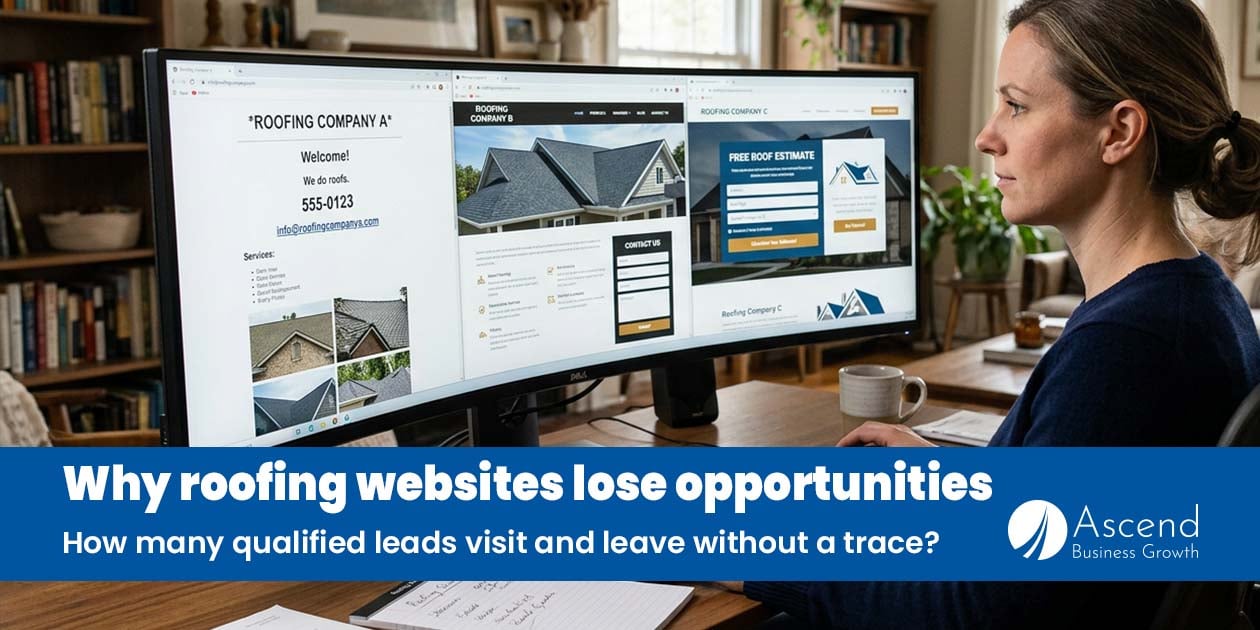
A homeowner needs a roof. Maybe they found you on Google, maybe they clicked an ad, maybe their neighbor gave them your name.
They pull up your website. Then they pull up two other roofing companies.
All three install roofs. All three have good reviews. All three say they do quality work. Now the homeowner is deciding who to contact.
You already spent the money, time or reputation it took to get onto that short list. That's a revenue leak — not a broken website, just one that doesn't make the next step obvious enough to win the comparison.
Here's the size of it. If your roofing website costs you one legitimate opportunity a month, and your average job is $12,000, that's $144,000 a year in work you never got to compete for. Not lost jobs. Jobs you were never in the running for.
This article covers what a roofing website needs to do, where homeowners drop off, and how to test it like a homeowner in about ten minutes.
Table of Contents
- Key takeaways
- What should a roofing website do?
- Why do homeowners choose one roofer over another?
- Are you giving homeowners the right ways to contact your roofing company?
- Is your roofing contact form helping or hurting?
- Is your online roof estimator helping someone take the next step?
- What happens after someone contacts you through your website?
- What could a roofing website leak be costing you?
- How to check your roofing website yourself
- What does a good roofing website look like?
- How does your roofing website fit into the bigger revenue picture?
- Find your roofing revenue leaks
- Roofing website FAQs
Key takeaways
- Your roofing website should help the right homeowner take the next step, not simply tell them about your company.
- Different homeowners want different contact options: phone, text, chat, forms, online estimates and scheduled conversations.
- Trust matters before the homeowner ever contacts you, and generic claims about quality workmanship give them nothing to compare.
- Forms and online roof estimators can generate opportunities or become dead ends, depending entirely on what happens next.
- You can find your first roofing website leak in about 10 minutes by experiencing your own site the way a homeowner would.
What should a roofing website do?
Your roofing website should help the right homeowner confidently take the next step with your company. That doesn't mean every visitor needs to fill out a form.
- Someone with water dripping into their kitchen wants to call immediately.
- Someone researching a replacement wants to understand your process, see previous projects and read reviews first.
- Someone budgeting for next year might use an online roof estimator.
- Someone with a question may want to chat or text.
- Someone who doesn't want an unexpected sales call may happily schedule a conversation for Tuesday at 6:00.
Those are different homeowners at different points in the buying process. Your website's job is making the right next step easy to find for each of them.
Why do homeowners choose one roofer over another?
Homeowners need enough information to decide whether they trust you enough to make contact. Generic promises about quality workmanship and excellent service give them nothing to compare.
Pull up two or three roofing competitors in your market. Chances are they make most of the same claims you do. If you want a structured way to review your own site, use this website evaluation checklist.
A homeowner considering a major investment in their home needs actual reasons to trust you:
- Reviews from real customers
- Photos of actual roofing projects
- The people behind the company
- Your experience in the local market
- Manufacturer certifications and relevant credentials
- Warranty and financing information
- Your service area
- What actually happens during an inspection or estimate
- Answers to common homeowner questions
- Clear information about the types of roofing work you do
None of that has to be on your homepage. But by the time someone decides whether to hand over their name, phone number and property address, your website should have answered one question:
Do I feel comfortable talking to these people about my house?
Are you giving homeowners the right ways to contact your roofing company?
Not every homeowner wants to contact a roofing company the same way. Your website should offer a reasonable next step based on what they need and how ready they are to talk.
I need roofing help now
Someone with an active leak isn't reading your About page or working through a six-step estimator. They want to reach somebody.
Make the phone number obvious, especially on mobile. Text or live chat may make sense depending on how you operate.
An obvious phone number only helps if it reaches someone, which is a separate problem — I covered it in the article on call routing problems that lose roofing jobs.
I want a roofing estimate
Someone considering a replacement is probably comparing several companies. Give them an obvious way to request an estimate, collect enough for your team to understand the job, and tell them what happens next.
I have questions, but I don't want to call right now
This is where a form, text, chat or online scheduling works well.
Instead of "Submit the form and we'll contact you," give the homeowner more control:
"Tell us a little about your roofing project, then choose a convenient time to talk with a member of our team."
They don't have to wait for an unexpected call, and your team doesn't spend three days playing phone tag.
Is your roofing contact form helping or hurting?
A roofing contact form should make starting a conversation easier and leave the homeowner confident that something will actually happen.
You've seen the basic version: name, email, phone, message, submit. There's nothing technically wrong with it. The problem is what it doesn't tell the homeowner.
- Why am I filling this out?
- What happens after I click Submit?
- Am I requesting an inspection, an estimate or a callback?
- When should I expect to hear from someone?
- Can I choose how or when we communicate?
Your form can also collect information that helps your team understand the opportunity before the first conversation. Depending on your business, that might be repair versus replacement, the property address, timing, whether it's an insurance claim, or preferred contact method.
The goal isn't the shortest possible form. Every question should earn its place.
"Do you need a repair, replacement or aren't sure?" tells your team why the homeowner is calling. "How did you hear about us?" is administrative work you're pushing onto the homeowner — your tracking should answer that one for you.
Is your online roof estimator helping someone take the next step?
An online roof estimator can be useful, but an instant estimate isn't the same as an answer. The tool should move a homeowner forward, not end the conversation.
Some homeowners want a sense of cost before talking to anyone, and an estimator gives them a low-pressure way in. But a roof isn't a product on a shelf with one price. They may still have questions about materials, ventilation, decking, insurance, financing, warranties, timing, or whether they need a full replacement at all.
So look carefully at what happens after someone uses yours.
- Can they easily ask a question?
- Can they schedule an inspection?
- Can they pick a convenient time to talk with someone?
- Does your company even know they used it?
- Does someone own the next step?
Or does the homeowner get a number and disappear?
Technology should make it easier to reach a human when the homeowner is ready. A simple alternative can be powerful:
Want a real answer from a real person? Choose a time to talk with us.
What happens after someone contacts you through your website?
The homeowner shouldn't have to wonder whether their request went through. Every contact option on your roofing website should end with a clear next step.
If someone submits a form, tell them what to expect. If they request an estimate, explain what happens. If they use the estimator, give them an easy way to ask a question. If they schedule a conversation, confirm the time and tell them who they'll be talking to.
A generic "Thanks! We'll be in touch" leaves them waiting with nothing. Use the confirmation to answer what they're actually wondering:
- Did you receive my request?
- What happens next?
- When should I expect to hear from someone?
- What should I do if I need help sooner?
The goal is simple: don't create uncertainty at the exact moment a homeowner has decided to contact you.
What happens inside your company after that request arrives matters too, but that's the next revenue leak.
What could a roofing website leak be costing you?
You don't need a national conversion benchmark to decide whether this matters. Use your own numbers.
Say one legitimate opportunity a month fails to make it cleanly from your website into your sales process. At a $12,000 average job, that's $12,000 a month, or $144,000 a year.
That does not mean you lost $144,000. You may not have won those jobs.
It means a homeowner was interested enough to take action, and a preventable problem removed you from consideration before your team ever got to compete. You paid to get on that short list either way.
That's the number worth finding.
How to check your roofing website yourself
You can find your first roofing website leak in about 10 minutes. Don't start in your analytics or your website backend. Pick up your phone and experience your own company like a homeowner.
Test 1 is the ten-minute one. Work through the rest as you have time — tests 4 and 6 are where most owners find something they didn't expect.
Test 1: My roof is leaking and I need somebody now
Search for your company on Google and enter the site the way a homeowner would. Now assume water is coming through your ceiling.
- Can you immediately tell your company handles this?
- Can you find the phone number without hunting?
- Is it click-to-call on mobile?
- Can you text or chat, if you offer those?
- Do you know what to expect after hours?
Test 2: I know I need a roof and I'm comparing companies
Now pretend you're planning a replacement with three roofing companies open on your phone.
- Can you quickly tell where the company works?
- Can you see actual reasons to trust them?
- Can you understand what services they offer?
- Can you easily request an estimate or inspection?
- Do you know what happens after you submit?
Test 3: I have questions but I don't want to call
Try to find another way to communicate. Can you submit a simple question? Text or chat? Schedule a time? Or does the site force you into a method you don't want?
Test 4: Submit your own roofing form
Actually submit it, then follow the lead.
- What happens immediately after you click Submit?
- Do you get a useful confirmation, and does it explain the next step?
- Where does the inquiry go inside your company?
- Who gets notified, and who is responsible for responding?
Test 5: Use your own roof estimator
If you have one, complete it like a homeowner. Don't stop when the estimate appears. Can you get to a real person? Does your team receive the information? Is there an obvious next step?
Test 6: Compare your site with two competitors
Open two local roofing competitors on your phone and repeat the exercise. Don't ask which website is prettier. Ask:
If I were the homeowner, which company would I feel most confident contacting, and which one makes it easiest to take the next step?
That's the comparison that matters, because it's the one the homeowner is actually running.
What does a good roofing website look like?
A good roofing website doesn't need to win a design award. It needs to make it easy for the right homeowner to confidently take the next step.
A homeowner should quickly understand what you do, where you work, why they should trust you, how to get immediate help, how to request an estimate, how to ask a question, how to schedule a conversation, and what happens after they contact you.
On your side, you should be able to tell where the opportunity came from, what the homeowner needs, who owns the next step, whether anyone responded, and whether it became an appointment, an estimate and eventually a job.
That's the bar. The homeowner gets an easy, credible experience. Your company gets an identifiable opportunity that someone owns.
How does your roofing website fit into the bigger revenue picture?
Your website is only one place roofing revenue leaks. Homeowners find you through Google Ads, Local Services Ads, organic search, your Google Business Profile, social media, referrals, repeat business and yard signs. Some visit the site. Some call directly. Some take an entirely different path.
Lead source → Lead capture → Response → Qualification → Appointment → Estimate → Follow-up → Sale → Measurement
Your website sits at lead capture, and it has an important job there. I wrote more about that in Your Website Is Your Most Powerful Sales Tool.
But getting someone to contact you only moves them to the next stage. Then somebody has to respond — and that's another place roofing revenue disappears.
This is one of eleven revenue leaks that waste good roofing leads, and most of them are just as quiet as this one.
Find your roofing revenue leaks
You may not need more leads. You may need to find out what's happening to the opportunities you're already generating.
The free Roofing Revenue Leak Check looks across your lead-to-revenue process to find where opportunities may be slipping through — from how homeowners find and contact you through response, appointments, estimates, follow-up, sales and measurement.
One short call, then I look at what's public: your ads, your listings, your site, the same way a customer finds you. You get a plain-English list of what may be leaking and roughly what it may be costing you. No pitch buried inside it.
Check your roofing revenue leaks →
Roofing website FAQs
What should a roofing website include?
A roofing website should clearly explain what services you provide, where you work, why homeowners should trust your company, and how to take the next step. Useful elements include reviews, actual project photos, credentials, warranty information, service areas, contact options, estimate requests, and an explanation of what happens after someone contacts you.
Does a roofing website need a contact form?
A contact form gives homeowners an option when they don't want to call immediately, but it shouldn't be the only way to reach you. Depending on your business, phone, text, chat, online estimating and scheduled conversations give homeowners additional ways to take the next step.
What questions should a roofing contact form ask?
Ask enough to understand the homeowner's needs and handle the inquiry appropriately, without making the form unnecessarily difficult. Name, contact information, property address, repair versus replacement, timing and preferred contact method may all be useful. Every question should have a business reason for being there.
Should a roofing company use an online roof estimator?
An online roof estimator helps homeowners who want preliminary pricing before speaking with anyone. It works best when the estimate leads naturally to another step, such as asking a question, scheduling an inspection, or choosing a time to talk with someone.
How can I tell if my roofing website is generating good leads?
Don't measure the website by traffic or form submissions alone. Track whether calls, forms, chats, estimate requests and scheduled conversations become identifiable opportunities, then follow those opportunities through appointments, estimates and completed jobs. That tells you whether the website is contributing to revenue rather than generating activity.


Comments