
Your roofing pipeline can show 180 open estimates and tell you nothing about which ones are still alive. Here's how to check your quote follow-up.
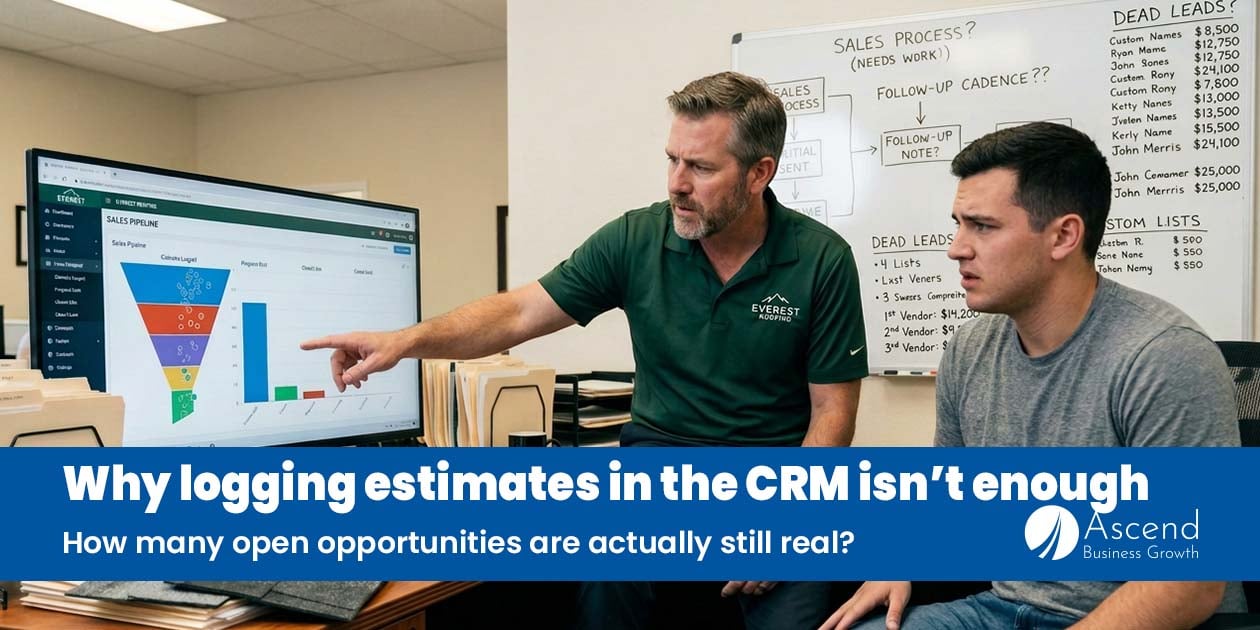
A roofing owner opens his pipeline on a Monday morning. One hundred eighty open estimates. About $2.1 million in potential work.
That looks like a good month coming.
Then he tries to answer a simpler question: which of those 180 is anybody actually working?
Not which ones exist. Which ones had a phone call last week. Which ones have a next step with a date on it. Which ones the homeowner has gone quiet on and nobody noticed.
He can't answer it. Neither can his software, because nothing in there was ever asked to.
That's a revenue leak, and it's a strange one. Nothing is lost. Every estimate is sitting right there, correctly recorded, exactly where it should be. The system is doing its job perfectly. It just isn't telling him anything.
What's missing is quote follow-up — a deliberate process for working estimates after they're delivered, so the ones worth chasing get chased and the dead ones get closed out instead of padding the number.
Here's the size of it. If 180 estimates are open at $12,000 average, and even 10% of them are recoverable jobs that quietly went cold, that's $216,000 sitting in a list nobody's working.
This article covers what your pipeline is actually telling you, why "open" is a meaningless status, what weak quote follow-up costs, and how to test your own backlog in about ten minutes.
Table of Contents
- Key takeaways
- What does your roofing pipeline actually tell you?
- Why "open" doesn't mean what you think it means
- Do you follow up as fast as you think you do?
- What happens after a homeowner says "let me think about it"?
- Why insurance work hides dead estimates
- Is improving your close rate a plan, or just the salesperson?
- What does weak quote follow-up cost a roofing company?
- How to check your quote follow-up yourself
- What does good quote follow-up look like?
- How does quote follow-up fit into the bigger revenue picture?
- Find your roofing revenue leaks
- Roofing quote follow-up FAQs
Key takeaways
- Most roofing pipelines report how many estimates are open and how much they're worth, and nothing about whether any of them are moving.
- "Open" usually means "not closed," which is not the same as still alive. A dead estimate looks identical to an active one until somebody checks.
- Roofing owners consistently believe their follow-up is faster and more thorough than it actually is, and the gap between belief and practice is wide.
- Insurance and storm work makes this worse, because legitimately slow estimates and genuinely dead ones look the same in a list.
- You can test your own backlog in about 10 minutes by asking how old your oldest open estimate is and who owns it.
What does your roofing pipeline actually tell you?
Most roofing pipelines are a count, not a measurement. They tell you how many estimates are open and what they add up to. They don't tell you whether any of it is progressing.
Those are different questions, and only one of them helps you.
A count answers: how much work might we get? That number feels good in a slow month, and it's almost entirely unreliable, because it includes estimates from March that nobody has touched since.
A measurement answers: Is this pipeline healthier than it was last month? How long does an estimate typically sit before it closes one way or the other? Which ones haven't moved and why?
Most roofing software will happily give you the first. Almost none of it gives you the second unless somebody set it up to, because the software's job is to record what happened—not notice what didn't.
That's where people get it backward. The gap isn't in the tool. It's that nobody ever told the tool what "stuck" looks like.
Why "open" doesn't mean what you think it means
In most roofing systems, "open" just means nobody has marked it closed. It is not a statement about whether the job is still winnable.
Think about what's actually inside a list of 180 open estimates.
- Some were delivered last week and the homeowner is genuinely deciding
- Some are waiting on an insurance adjuster
- Some the homeowner already gave to a competitor and never told you
- Some the homeowner decided to wait until next spring
- Some were bad fits that should have been disqualified on the first call
- Some are duplicates of a job you already sold under a different address format
- And some are real, warm, and slowly going cold because nobody has called in five weeks
Every one of those shows up in your pipeline the same way. Same status, same dollar value, same contribution to the total.
So the $2.1 million isn't wrong, exactly. It's just not information. You can't make a decision with it, can't forecast from it, and can't tell your crew scheduler anything useful based on it.
The number that matters isn't how many estimates are open. It's how many are moving.
Do you follow up as fast as you think you do?
Almost certainly not, and this is one of the widest gaps between belief and practice in the trades.
Follow-up usually looks better in theory than it does in practice. The problem isn't whether your team ever follows up. It's whether follow-up still happens during a bad week, when crews, customers and production problems are competing for everyone's attention.
Sit with those two numbers. Two-thirds believe it's how they operate. One in six can hold to it.
That gap doesn't come from laziness. It comes from follow-up being the thing that gets dropped when something louder happens — and in a roofing company, something louder always happens. A crew hits rotten decking. A supplier shorts a delivery. A homeowner calls angry about a gutter. The estimate from Tuesday can wait until tomorrow.
The useful version of this question isn't "do we follow up?" Everyone follows up sometimes. It's: what happens to follow up on a bad week?
If the honest answer is "it doesn't," you don't have a follow-up process. You have a follow-up intention, and it's the first thing that goes when the business gets busy — which is exactly when you're producing the most estimates.
What happens after a homeowner says "let me think about it"?
That sentence is where most roofing estimates go to die, because it sounds like a conclusion and it isn't.
The homeowner isn't stalling. They're doing exactly what a reasonable person does with a $12,000 decision about their house. They want to talk to their spouse. They want to see the other two quotes. They want to check whether the roof can survive another winter.
What they almost never do is call you back.
Not because they didn't like you. Because calling a contractor back feels like committing, and they're not ready to commit, and the longer it goes, the more awkward it feels to reopen it.
So the entire outcome of that job depends on whether somebody at your company reaches back out. And in most roofing companies, whether that happens depends on which estimator sat at that kitchen table.
Two things make the difference here, and neither is complicated.
Set the next contact before you leave. "I'll check in Thursday afternoon" turns an open-ended wait into an appointment. It also gives the homeowner permission to not decide right now, which reduces the pressure that makes people avoid the callback.
Write it down somewhere other than your own head. A next step with a date, visible to someone besides the person who set it. That's the difference between a process and a good intention.
Why insurance work hides dead estimates
Storm and insurance jobs legitimately sit for weeks, which makes it nearly impossible to spot the ones that actually died.
A homeowner is waiting on an adjuster. A supplement is under review. A claim came back partially denied, and they're deciding whether to appeal. None of that is anyone's fault, and none of it means the job is lost.
But it means your backlog is full of estimates that look stalled and aren't. Which is exactly why nobody audits the backlog — at a glance you can't tell which ones deserve attention, so the whole list gets treated as noise.
That's where genuinely dead opportunities hide. An estimate that went cold in October looks identical to one waiting on an adjuster, unless somebody wrote down which is which.
This is the one place where a status that means something earns its keep. "Waiting on adjuster, check back the 14th" is a different thing from "no contact since October." A pile can't tell you the difference. A list with a reason and a date can.
Is improving your close rate a plan, or just the salesperson?
In most roofing companies, conversion isn't managed. It's inherited from whoever happens to be selling.
Here's a question worth asking yourself honestly: if your close rate went up four points next quarter, could you tell me what caused it?
If the honest answer is a shrug — good market, good guys, good month — then you can't repeat it. And if you can't repeat a good quarter, you can't prevent a bad one either.
The tell is what you'd do if you wanted to improve it. Most owners, asked that question, say some version of "push the guys harder" or "hire a better closer." Both are bets on individuals. Neither is a plan, and neither survives that person leaving.
A plan looks different. It means knowing where estimates actually die — at the kitchen table, in the week after, at the price conversation, waiting on insurance — and working on that one point. It means your second-best estimator gets better because the process helps him, not because he eventually figures out what your best seller is doing.
None of that requires sales training. It requires knowing which stage leaks, and you can't know that when your pipeline only reports how many deals are open.
What does weak quote follow-up cost a roofing company?
This leak is more expensive than the ones upstream, because you've already paid for everything except the sale.
By the time an estimate exists, you've spent marketing money to generate the lead, office time to schedule it, drive time, measuring time and estimating time. All of it is sunk. The only thing missing is the next conversation.
Go back to the owner at the start. These are illustrative numbers — use your own.
180 open estimates at a $12,000 average is $2.16 million on paper. Suppose 10% of those are real opportunities that quietly went cold because nobody came back to them. That's 18 jobs, $216,000, sitting in a list.
You won't win all 18. You might win three. At a $12,000 average job, that's $36,000 in recovered revenue and about $10,800 in margin at a 30% margin — from opportunities you already paid to create.
And unlike buying more leads, recovering those costs you nothing but phone calls.
If the dollar math feels too speculative, use numbers that aren't:
- How old is your oldest open estimate?
- How many estimates have had no contact in 30 days?
- How many have a next step with a date on it?
- How many can you name an owner for?
If you can't answer those, that's the finding.
How to check your quote follow-up yourself
You can find out whether you have this leak in about 10 minutes. Don't announce it as an audit. You're not checking up on anybody — you're checking whether the business can see its own work.
Test 1: Find your oldest open estimate
Open your pipeline and sort by date. What's the oldest thing still sitting in there?
If you find estimates from eight months ago still marked open, nothing in your system is aging. Opportunities don't get closed; they just fade — which means they never get counted as losses and never get a last phone call.
Test 2: Count what hasn't moved in 30 days
How many open estimates have had no logged contact in the last month?
Then ask the harder version: can your system even tell you that? If finding out requires opening records one at a time, your pipeline isn't reporting on activity at all.
Test 3: Pick five and find the next step
Choose five open estimates at random. For each one:
- Who owns it, by name?
- What is the next step?
- When is it happening?
- When did somebody last talk to this homeowner?
- What did the homeowner say?
Five out of five is good. Two out of five is the finding.
Test 4: Follow one dead quote all the way back
Pick a homeowner who got an estimate six to eight weeks ago and didn't buy. Trace the whole thing. Who contacted them, when, how, and what did they say? Is any of it written where another person could read it? Has anyone ever formally closed it out?
Test 5: Ask what happens on a bad week
Ask an estimator directly: when you've got three crews with problems and a supplier issue, what happens to your follow-up?
Nobody will say "it stops." Listen for how long the pause is before they answer.
Found estimates with no next step?
That may not be the only place good opportunities are getting lost. The free Roofing Revenue Leak Check reviews your process to find other gaps costing you jobs.
Check your roofing revenue leaks →
What does good quote follow-up look like?
Every open estimate has a name on it, a next step with a date, and a real ending. That's the bar, and it doesn't require buying anything.
A name, not a department. "The office will handle it" means nobody will. One person is responsible for what happens next on each estimate.
A next step with a date. "Follow up soon" isn't a next step. "Call Thursday after the adjuster visit" is. This is also what separates a genuinely stalled deal from one that's waiting for a reason.
A cadence the homeowner knows about. Tell them at the kitchen table when you'll check back, then do it. For insurance work, tie the next contact to the next event in the claim rather than an arbitrary number of days.
A real ending. Every estimate eventually gets sold or closed out, on purpose, by somebody. Estimates that fade instead of closing are how a company loses track of its own close rate.
A number you watch. Pick one: estimates with no contact in 30 days, or average days from estimate to decision. Look at it monthly. That single number turns your pipeline from a count into a measurement — assuming somebody's job includes looking at it.
Notice what isn't on that list. Nobody has to buy software, change how they write estimates, or sit through sales training. Most roofing companies already have a system that could do all five of these. It just isn't set up to, because nobody has ever told it what to watch for.
How does quote follow-up fit into the bigger revenue picture?
This is the most expensive leak in the process, because it's the last one before the money.
Lead source → Lead capture → Response → Qualification → Appointment → Estimate → Follow-up → Sale → Measurement
Every leak earlier in that chain costs you an opportunity you never had. A phone number that didn't ring, a website that didn't earn the call — those are homeowners you never met.
This one costs you homeowners you already met. You generated them, drove to them, climbed on their roof, measured it and priced it. Everything is spent except the phone call.
It's also the leak that most directly determines whether the stage after it — the sale — ever happens at all. There's no closing technique that rescues a conversation nobody had.
This is one of fifteen revenue leaks that waste good roofing leads, and this one is the most expensive of them.
Find your roofing revenue leaks
You may not need more leads. You may need to find out what's happening to the estimates you've already produced.
The free Roofing Revenue Leak Check looks across your lead-to-revenue process to find where opportunities may be slipping through — from how homeowners find and contact you through response, appointments, estimates, follow-up, sales and measurement.
We start with one short call. Then I look at what's public and, where it helps, what's happening inside your process. You get a plain-English list of what may be leaking, roughly what it may be costing you, and what I'd fix first. If nothing's leaking, you'll know that for certain instead of guessing. No pitch buried inside it.
Check your roofing revenue leaks →
Roofing quote follow-up FAQs
How often should a roofing company follow up on a quote?
Follow up on a schedule the homeowner knows about rather than one you guess at. Tell them at the kitchen table when you'll check back, then do it. For insurance work, tie the next contact to the next event in the claim, such as the adjuster visit or the supplement decision, instead of an arbitrary number of days.
How should a roofing company track open estimates?
Every open estimate should show who owns it by name, what the next step is, when that step happens, and when someone last spoke to the homeowner. If answering those questions means opening records one at a time, your pipeline is storing estimates rather than managing them.
When should you close out an unsold roofing estimate?
Close it when you've made a decision to, not when you've forgotten about it. Some companies use a time rule, such as no contact in 90 days, and others close after a specific number of unanswered attempts. Either works. What matters is that estimates end on purpose, because a pipeline full of estimates nobody ended can't tell you your real close rate.
How do you follow up on roofing estimates waiting on insurance?
Record what the estimate is waiting for and the date you expect it to change, then check back against that date rather than treating it as a general stall. Insurance jobs legitimately sit for weeks, which is exactly why they need a reason and a date attached — otherwise they're indistinguishable from estimates that died.
How can a roofing company improve its close rate?
Start by finding out where estimates actually die, rather than pushing harder across the board. If most of your losses happen in the two weeks after the estimate is delivered, that's a follow-up problem, not a selling problem, and the fix is a cadence rather than sales training. You can't work on the right stage until the pipeline tells you which stage is leaking.


Comments