
When two estimators at the same company close at very different rates, the difference usually isn't talent. Here's what a roofing sales process actually needs.
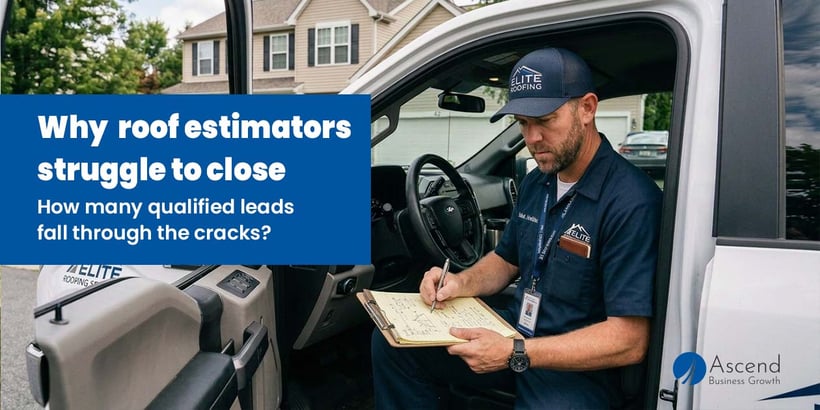
Two estimators work for the same roofing company. Same leads, same pricing, same territory, same shingles.
One closes a little over a third of what he quotes. The other closes about a fifth.
The obvious explanation is that the first guy is better. Usually, he is. But watch what actually happens after each of them leaves the kitchen table, and the difference gets more specific than talent.
The one closing well sends a follow-up the same evening with photos from the inspection, a page explaining the warranty, and financing numbers. He sets the next call before he leaves the driveway. He's been doing it for eleven years, and it's automatic.
The other one leaves a price. He means to send something. He's not sure what he'd send, or where the warranty page lives, or whether there is one.
That's a revenue leak, and it isn't a people problem. Your best estimator built a sales process in his own head over a decade. Nobody else has access to it.
What's missing is a roofing sales process — a defined set of steps, tools and materials that makes the good version of the job the easy version, instead of something each person has to invent.
Here's the size of it. Two estimators delivering 20 estimates a month, one at 38% and one at 22%, is about three jobs a month of difference. At $12,000 average, that's roughly $38,000 a month between two people doing the same job.
This article covers why that gap exists, what homeowners actually need in order to say yes, what belongs in a roofing sales content library, what to measure, and how to check what your own process really looks like.
Table of Contents
- Key takeaways
- What is a roofing sales process?
- Why do two estimators at the same company close so differently?
- What does a homeowner actually need in order to say yes?
- What does your estimator leave behind?
- What belongs in a roofing sales content library?
- Don't templates make follow-up feel impersonal?
- What should you measure in a roofing sales process?
- What this does for a new salesperson
- What does a missing roofing sales process cost?
- How to check your own roofing sales process
- What does a good roofing sales process look like?
- How does your sales process fit into the bigger revenue picture?
- Find your roofing revenue leaks
- Roofing sales process FAQs
Key takeaways
- When two estimators close at very different rates, the gap is usually tools and habits rather than talent.
- A roofing sales process should make the good version of the job the easy version, not add paperwork to it.
- Homeowners are making a large decision about their house with someone they just met. What you leave behind is most of what they use to decide.
- A small library of answers to the questions every homeowner asks means your whole team answers them the same way, well.
- Measuring activity tells you what to fix while you can still fix it. Measuring only closed jobs tells you what already happened.
What is a roofing sales process?
A roofing sales process is the defined sequence of what happens between a homeowner's first contact and a signed job, along with the tools and materials that make each step easy to do well.
That second half matters more than the first, and it's the part most companies skip.
Plenty of roofing companies have a process on paper. Call within an hour, inspect within two days, present the estimate, follow up. Fine as far as it goes, and it tells nobody what to actually do.
A real process answers the practical questions. What does the estimator show the homeowner at the table? What goes in the follow-up message, and who wrote it? Where does the financing explanation live? When a homeowner asks about warranties, does everyone give the same answer?
Without those, "follow up" is an instruction to improvise. Some people improvise well. Most don't, especially under pressure, and nobody improvises consistently for years.
Why do two estimators at the same company close so differently?
Because your best estimator built himself a sales process over years, and it lives entirely in his head.
He knows which three photos to show first. He knows how to explain decking without making it sound like an upsell. He knows the objection that comes after the price and what to say to it. He knows to mention financing before the homeowner has to ask.
None of that is written anywhere. He couldn't fully explain it if you asked — it's eleven years of adjustments that now feel like instinct.
So your second estimator isn't failing to follow the process. There is no process to follow. He's being asked to rebuild the same decade of trial and error himself, alone, while carrying a quota.
The usual response to this gap is to push harder or hire better. Both are bets on individuals, and neither survives that person leaving.
The alternative is unglamorous: get some of what's in the good estimator's head into a form the other one can use. Not a script. A handful of materials and a few defined steps.
What does a homeowner actually need in order to say yes?
They need enough confidence to hand a large amount of money to somebody they met an hour ago, about a part of their house they can't see.
That's the actual task. Not persuasion — most homeowners contacting a roofer already know they need work done. What they don't know is whether you're the right company and whether the number is fair.
And they're deciding largely from things you control:
- Whether you showed them what's actually wrong, or just told them
- Whether the price came with an explanation of what's in it
- Whether their specific question got a real answer or a vague one
- Whether anything you left behind helps them explain it to their spouse
- Whether you did what you said you'd do, when you said you'd do it
That last one does more work than anything else on the list. A homeowner who was told "I'll send the warranty details tonight" and receives them at 7pm has learned something real about how your company operates. So has the one who didn't.
It starts earlier than the kitchen table, too. By the time your estimator arrives, the homeowner has already formed an impression from what your website told them and how long it took somebody to call back.
The estimator with good materials isn't more persuasive. He just looks like someone who's done this before.
What does your estimator leave behind?
In most roofing companies, the answer is a number. And the homeowner then goes and makes a $12,000 decision using that number and their memory of a conversation.
Remember what happens after you leave. They're comparing you to two other companies. They're explaining the job to a spouse who wasn't home. They're looking at three prices that don't cover the same scope and trying to figure out why one is $4,000 higher.
If the only thing you left is a total, you've handed them a price comparison. That's the one comparison where the cheapest company wins.
What changes the conversation is material that helps them understand the decision:
- Photos from your own inspection, of their roof, with a sentence about each
- What's included in the price and what isn't, plainly
- What happens on install day, so they can picture it
- Warranty terms, in language a person can read
- Financing options, if you offer them
- A couple of recent jobs nearby
That last one is free if somebody is photographing your finished work. Most roofing companies have hundreds of completed jobs and no pictures of any of them.
None of that is a sales pitch. It's the stuff a homeowner needs anyway, and giving it to them is the part your competitor probably skipped.
What belongs in a roofing sales content library?
The answers to the questions every homeowner asks, written once, well, so nobody has to improvise them at a kitchen table.
You already know what the questions are. Your team answers them every week:
- Why is your price higher than the other quote?
- Do I really need a full replacement, or can this be repaired?
- What happens if you find bad decking once you tear off?
- How does the warranty work, and what voids it?
- How does financing work and what does it actually cost me?
- What happens to my landscaping and my driveway?
- How does this work with my insurance claim?
- How long will it take and what if it rains?
Right now, each of those gets answered from memory, differently, by different people, with varying accuracy. Your best estimator answers them well. Your newest one answers them nervously, and the homeowner can tell.
A library is just those answers written down — a page each, plain language, ready to send or hand over. Ten of them covers most of what comes up.
The decking question is worth writing carefully, because a homeowner who was warned in advance reacts very differently to a change order than one who finds out on tear-off day.
Two things make this worth the afternoon it takes. The estimator stops inventing answers under pressure, and the homeowner gets something to show their spouse that isn't a price.
Don't templates make follow-up feel impersonal?
The realistic comparison isn't a template versus a thoughtful personal message. It's a template versus nothing at all.
That's the part that gets missed. When every follow-up has to be written from scratch, at the end of a long day, by somebody who isn't a writer, a lot of them simply don't get sent. The estimator means to. Then it's 8pm.
A template removes the blank page. The estimator adds the homeowner's name, the specific thing they were worried about, and a line about what he saw on their roof. Two minutes instead of twenty, and it goes out.
What makes templated follow-up feel personal is specificity, not originality. "The valley over your garage is where the staining is coming from" is personal. Whether the paragraph underneath it was typed fresh doesn't register to anyone.
The failure mode is real, though: a template sent with nothing added is worse than useless, and homeowners recognize a form letter instantly. The rule worth holding is that every message has at least one sentence that could only have been written about that house.
What should you measure in a roofing sales process?
Measure the activity, not just the outcome, because activity is the part you can still change.
Most roofing companies track one number: jobs sold. That's a result, and by the time you see it, everything that produced it already happened.
Activity measures tell you what's happening now:
- Estimates delivered per person
- How many got a follow-up within 24 hours
- How many touches an average estimate receives before it closes or dies
- Days from inspection to estimate delivered
- How many estimates currently have a next step with a date
Those five tell you where to look. If one estimator delivers as many estimates as another but closes half as many, that's a conversation about the kitchen table. If he delivers half as many, that's a completely different conversation about scheduling and capacity.
Without activity numbers, every performance conversation is a guess dressed up as feedback. And the person on the receiving end knows it.
One caution: measured activity becomes gamed activity if you're not careful. Counting follow-ups produces follow-ups — some of them meaningless. Watch a couple of numbers, tie them to something real like whether the homeowner responded, and don't build a scoreboard nobody believes in.
What this does for a new salesperson
The time it takes a new roofing salesperson to become productive is mostly a measure of how much your process lives in one person's head.
Ask yourself how long it takes a new hire to reach full production. If the honest answer is six to nine months, that's not because roofing is hard to learn. It's because they're rebuilding your best estimator's decade of material from scratch, by failing in front of homeowners.
Every one of those failures is a real job, with real marketing money behind it, lost to the learning curve.
A company with defined steps and a content library doesn't make new hires great immediately. It makes them adequate quickly, which is a much bigger financial difference than it sounds. Adequate closes jobs. Lost closes nothing.
It also changes what happens when someone leaves. If your best estimator gave notice tomorrow, how much of what he knows walks out with him?
What does a missing roofing sales process cost?
The gap between your best estimator and your average one, multiplied by every estimate the average one delivers.
These are illustrative numbers. Use your own.
Two estimators each deliver 20 estimates a month. One closes 38%, the other 22%. That's 7.6 jobs versus 4.4 — a difference of about three jobs a month.
At a $12,000 average, that's roughly $38,000 a month, or around $460,000 a year, between two people selling the same work at the same prices.
You won't close the whole gap. Some of it is genuinely the person. But if better materials and a defined process move the second estimator from 22% to 28%, that's more than a job a month, from an afternoon of writing and a shared folder.
There's a second cost that doesn't show up in close rate. Every estimate that gets delivered and then forgotten used marketing money, drive time, inspection time and estimating time. Those costs are identical whether the follow-up happened or not.
How to check your own roofing sales process
You can find out what your process really looks like in about 10 minutes, and the first test is the one that matters.
Test 1: Ask two people to describe what happens after the kitchen table
Ask two estimators separately: walk me through everything you do after you leave a homeowner's house with an estimate delivered.
Write both answers down. Then compare them.
If they describe different things — different timing, different materials, different number of follow-ups — you don't have a sales process. You have two people each doing their own.
Test 2: Ask to see the last three follow-up messages
Not a description. The actual messages, sent to actual homeowners in the last two weeks.
- Did they get sent at all?
- Do they say anything specific about that homeowner's roof?
- Do they include anything beyond the price?
- Would you be comfortable if a homeowner forwarded one to a competitor?
Test 3: Find out what gets left behind
Ask what a homeowner physically has after your estimator leaves. Then ask for a copy.
If it's a number on a page, you've found something worth fixing this week.
Test 4: Try to answer a homeowner question from your own materials
Pick a common one — what happens if you find bad decking, or how does the warranty work. Now find the company's written answer.
If there isn't one, every person on your team is answering it from memory, and you've never seen most of those answers.
Test 5: Count last month's follow-ups
How many estimates did each person deliver last month, and how many received a follow-up within 24 hours?
If you can't produce those two numbers, that's the finding. You're managing sales performance on impressions.
Found a sales process gap?
The free Roofing Revenue Leak Check looks for the other places where your sales process may be costing you opportunities and jobs.
Check your roofing revenue leaks →
What does a good roofing sales process look like?
The right thing to do is written down, easy to find, and faster than improvising. That's the whole test. If following the process is harder than winging it, nobody will follow it and they'll be right not to.
Defined steps, not a script. What happens at the inspection, what gets delivered and when, what the first follow-up looks like, how many touches before you close it out. Five or six steps, not a manual.
A small content library. Ten written answers to the questions homeowners actually ask, in a folder anybody can reach from a truck.
Follow-up templates that require personalizing. A starting point with a blank that only gets filled in by somebody who was at that house.
A defined set of touches after the estimate. Not automated spam — a plan. Same evening, three days, the following week, then a decision about whether it's still alive.
Two or three activity numbers, watched monthly. Estimates delivered, follow-up within 24 hours, and how many open estimates have a next step. Enough to see where the process breaks without turning into a surveillance program.
Almost none of this requires buying anything. Most roofing companies already have a place to put the library and a way to send templated messages. What's missing is the decision to write the material down once.
How does your sales process fit into the bigger revenue picture?
The sales process is what determines whether everything you spent upstream turns into a job.
Lead source → Lead capture → Response → Qualification → Appointment → Estimate → Follow-up → Sale → Measurement
This one doesn't sit at a single stage. It runs across the appointment, the estimate, the follow-up and the sale — which is why it's harder to see than the others and why it has more leverage than any of them.
It's also the stage where the money is most already spent. A homeowner at a kitchen table cost you a lead, a response, a qualification, a drive and an inspection. Everything before this point was buying the chance to have that conversation.
And it compounds with the stage after it. A homeowner who got photos, a warranty explanation and a call when promised is easier to follow up with next week, because the relationship already has something in it.
This is one of fifteen revenue leaks that waste good roofing leads, and it's the one hiding inside your close rate.
Find your roofing revenue leaks
You may not need more leads. You may need to find out why two people selling the same work get different results.
The free Roofing Revenue Leak Check looks across your lead-to-revenue process to find where opportunities may be slipping through — from how homeowners find and contact you through response, appointments, estimates, follow-up, sales and measurement.
We start with one short call. Then I look at what's public and, where it helps, what's happening inside your process. You get a plain-English list of what may be leaking, roughly what it may be costing you, and what I'd fix first. If nothing's leaking, you'll know that for certain instead of guessing. No pitch buried inside it.
Check your roofing revenue leaks →
Roofing sales process FAQs
What is a roofing sales process?
A roofing sales process is the defined sequence of steps between a homeowner's first contact and a signed job, plus the materials that make each step easy to do well. The steps alone aren't enough. Without templates, photos, warranty and financing explanations and a follow-up plan, "follow up with the customer" is an instruction to improvise.
How can a roofing company improve its close rate?
Start by finding where estimates actually die rather than pushing across the board. If your best estimator closes far better than your average one on the same leads, the gap is usually in what happens after the kitchen table, and that's fixable with materials and a defined follow-up plan rather than sales training.
What should be in a roofing sales content library?
Written answers to the questions homeowners ask every week: why your price differs from another quote, repair versus replacement, what happens if decking is bad, how the warranty works, how financing works, what install day looks like, and how insurance claims are handled. A page each is enough. Ten of them covers most conversations.
What sales numbers should a roofing company track?
Track activity alongside results. Estimates delivered per person, how many received a follow-up within 24 hours, days from inspection to estimate, and how many open estimates have a next step with a date. Those tell you where the process is breaking while you can still do something about it.
Do sales templates make roofing follow-up feel impersonal?
The realistic comparison isn't a template versus a thoughtful custom message. It's a template versus a follow-up that never gets sent, because writing from scratch at the end of a long day usually doesn't happen. What makes a message feel personal is one specific line about that homeowner's roof, not whether the rest was written fresh.


Comments