
The estimator knew about the third layer. The crew didn't. Here's what a broken sales-to-production handoff costs a roofing company.
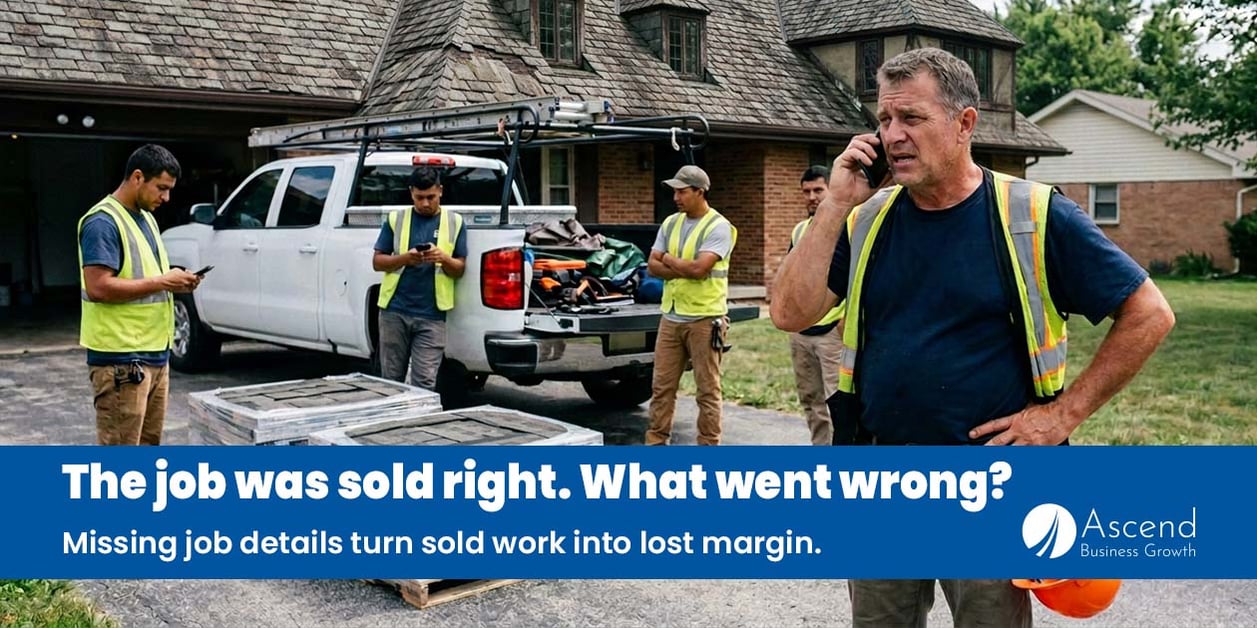
A crew pulls up at 7 am for a tear-off. Three guys, a dump trailer, and enough shingles for one layer.
They get up there and find three layers. The estimator knew — he wrote it down, priced it in, and the homeowner paid for it. That information just never made it to the truck.
So now the crew lead is calling the office from a roof. Somebody has to run for a bigger dumpster and more disposal. Half a day has gone by before anybody swings a hammer, and the homeowner is standing in the driveway watching three men wait.
Nobody did anything wrong. The estimate was right. The crew was competent. The customer paid the correct price.
That's a revenue leak, and it's a different kind than most. The job is already sold. What leaks is the margin between what you priced and what it actually costs to deliver.
What's missing is the handoff from sales to production — everything the estimator learned, promised, and excluded, arriving intact with the people doing the work.
Here's the size of it. Half a crew-day is a few hundred dollars in labor plus a truck run plus whatever the delay does to the rest of the week's schedule. On a $12,000 job at 30% margin, one bad morning can take a fifth of the profit.
This article covers what actually has to travel from the estimate to the crew, why it usually doesn't, what it costs in margin rather than lost leads, and how to check your own handoff.
Table of Contents
- Key takeaways
- What is the sales-to-production handoff?
- What actually has to reach the crew?
- Why the handoff breaks in roofing specifically
- The promises nobody wrote down
- When the schedule changes and the customer finds out last
- Change orders that never get billed
- What does a broken handoff cost a roofing company?
- How to check your own handoff
- What does a good roofing handoff look like?
- How does the sales handoff fit into the bigger revenue picture?
- Find your roofing revenue leaks
- Roofing sales handoff FAQs
Key takeaways
- This leak costs margin rather than leads. The job is sold; what's lost is the difference between what you priced and what it costs to deliver.
- The estimator learns things at the house that never reach the crew, usually because there's nowhere for that information to go.
- Most customer complaints about roofing companies are expectation failures, not workmanship failures.
- Change orders discovered mid-job often go unbilled, because nobody wants that conversation on a lawn.
- For one to three crews this is a checklist problem. Past four crews or with subcontractors, it's a system problem.
What is the sales-to-production handoff?
The handoff is everything that has to travel from the person who sold the job to the people who build it. Scope, conditions, materials, promises, timing, and anything unusual about the house or the homeowner.
In a lot of roofing companies, this happens through a work order, a text message, and a conversation in the shop. Sometimes it's the same person on both ends, which feels like it solves the problem and doesn't — an owner who estimated a job in March is relying on his own memory in May.
The reason it matters more in roofing than in most trades is the gap between selling and building. Somebody walks a roof, gets in a truck, and days or weeks later, a different group of people shows up to do work based on what that first person saw.
Everything that person noticed has to survive that gap. Whatever doesn't survive gets rediscovered on the roof, at the worst possible moment, in front of the customer.
What actually has to reach the crew?
More than the address and the shingle color, most of it is what the estimator noticed rather than what he priced.
The practical list:
- Conditions. Layers, decking condition, ventilation, flashing, anything already failing. What he saw and what he assumed.
- Scope, including exclusions. What's in the price and what specifically isn't. Gutters, skylights, chimney flashing, and the detached garage.
- Access. Where the dumpster goes, which side to stage from, the neighbor's fence, the septic field you can't drive across, the tree in the way.
- Materials. Not just quantity — anything nonstandard, and anything ordered separately.
- Promises. Everything said out loud to the homeowner that isn't in the contract.
- The house and the people. Dogs, kids napping, a night shift worker, a homeowner who wants a text before anyone arrives, the pool cover, the koi pond.
- Special conditions. Insurance scope, HOA rules, permit requirements, a supplement still in process.
Now compare that to what a typical work order carries. Address, customer name, shingle type, square count, start date.
The gap between those two lists is where the margin goes.
Why the handoff breaks in roofing specifically
Because the person who knows the most about the job is the one least available to explain it.
Your estimator is out selling. That's what you want him doing. He's not sitting at a desk writing detailed production notes; he's driving to the next appointment and the one after that.
A few other things make it harder than it looks:
Time passes. Two to six weeks between estimate and install is normal. Details fade even for the person who saw them.
The owner is often the estimator. In a lot of roofing companies, the owner sells the work, which means the handoff is from him to himself, which means it feels unnecessary to write anything down. Then he's on a different roof when the crew hits the surprise.
Nothing forces the information out. An appointment forces a record. A payment forces a record. Knowing there's a soft spot over the garage forces nothing, so it lives in someone's head until it doesn't.
The work order was designed for billing. Most of them exist to tell you what to charge, not to tell a crew what they'll find.
None of this is a discipline problem. It's a structural one, and it's why telling people to communicate better never works. It's also the same shape as everything else that lives in one estimator's head and nowhere else.
The promises nobody wrote down
Most angry roofing customers aren't upset about the roof. They're upset that something they were told didn't happen.
Think about what gets said in a driveway at the end of an estimate. We'll move the satellite dish. We'll be careful with the flower beds. We can start on Tuesday. We'll haul the old gutters. My guys will text before they come.
Every one of those is reasonable, probably true when said, and completely invisible to the crew that shows up three weeks later.
So the homeowner experiences a company that told her one thing and did another. The crew experiences a homeowner who's angry for no reason. Both are right, and neither knows why it happened.
This is the part that costs more than the half-day of labor. A customer who feels misled doesn't leave a review, doesn't refer a neighbor, and tells people at work about it. You paid marketing money to acquire her, then lost the most valuable thing the job produced.
The fix is unglamorous: whatever gets promised out loud gets written where the crew will see it. One line each.
When the schedule changes and the customer finds out last
Roofing schedules move constantly, and the person most affected is usually the last to know.
It rains on Tuesday. A tear-off runs long. A crew calls in short. Everything slides, and the office knows, and the crews know, and the homeowner who took a day off work finds out when nobody shows up.
What makes this particularly costly is that the customer's judgment of your company is being formed right here, in the gap between what you said and what happened. A delay you explain in advance is weather. A delay she discovers by waiting in an empty driveway is unreliability.
The operational version of this is just as expensive. When schedules move by phone call and text, nobody has the full picture. Two crews get sent to the same neighborhood, a dumpster arrives four days before the tear-off, and material gets delivered to a house nobody's working on until next week. That's a leak with its own price tag, and it compounds with this one.
Every one of those is a small cost that lands on a specific job's margin, and none of them show up anywhere you'd notice.
Change orders that never get billed
Roofing crews find things. What happens next decides whether the discovery costs you money or not.
Rotten decking is the obvious one. Somebody gets up there, finds twelve sheets that need replacing, and now there's a decision to make on a roof with a customer nearby.
In a company with a process, that's routine: the condition is documented, the customer is told, the price is agreed, the work proceeds. In a company without one, it goes one of two bad ways. The crew replaces the decking, and nobody bills for it, because by the time anyone thinks about it, the job is done and the invoice went out. Or somebody has an uncomfortable conversation on a lawn with a homeowner who wasn't warned this was possible, and the job ends badly, even though everyone behaved reasonably.
The unbilled version is the more common one, and it's pure margin. Materials plus labor, absorbed silently, on a job you already priced — and it's one of the reasons job costing stops reflecting reality.
Two things prevent most of it. Warn the homeowner at the estimate that this happens and what it typically costs, so nobody is surprised. And give the crew a defined way to document and approve it that takes minutes rather than a phone tree.
What does a broken handoff cost a roofing company?
This leak comes out of the margin on jobs you already won, which makes it harder to see and more expensive than it looks.
These are illustrative numbers. Use your own.
Say a crew of three costs you roughly $150 an hour, all in. A half-day lost to a missing dumpster or wrong materials is about $600, plus a truck run, plus whatever it does to the next job on the schedule.
If that happens on one job in ten and you do 150 jobs a year, that's 15 incidents and roughly $9,000 in direct labor waste, before counting the schedule disruption.
Now add the unbilled change orders. If four decking replacements a year go out the door unbilled at $800 each, that's another $3,200 straight off the bottom line.
And add what you can't put a number on: the customer who was promised something nobody wrote down, who doesn't leave the review and doesn't refer the neighbor.
All of it lands on jobs you already sold, already paid to acquire, and already scheduled. That's what makes it different from every leak upstream. You didn't lose the work. You just made less on it than you priced.
How to check your own handoff
You can find this leak in about 10 minutes, and the first test tells you most of what you need.
Test 1: Pick a job and compare what was known to what was sent
Take a job you completed in the last month. Put the estimator's notes next to whatever the crew actually received.
What did the estimator know that the crew wasn't told? That gap is your handoff, and it's usually wider than anyone expects.
Test 2: Ask a crew lead what surprised him this month
Just ask. Not as a complaint session — as a question.
What did you get to a job and find out that you wish you'd known before you left the shop? You'll get a list, and it'll be specific.
Test 3: Count last month's return trips
How many times did somebody have to go back for materials, a dumpster, a tool, or a second visit that wasn't planned?
If nobody can produce that number, that's the finding. Return trips are one of the purest measures of handoff quality, and almost nobody tracks them.
Test 4: Find a change order and follow the money
Pick a job where the crew found bad decking. Was it documented? Was the customer told before the work happened? Was it billed?
Do this for three jobs. If one of the three went unbilled, you have a number worth chasing.
Test 5: Ask a recent customer what she expected
Call somebody whose job finished last month and ask an open question about how it went compared to what she was told.
Listen for small things — the start date, the cleanup, something someone said they'd do. Those are the promises that never made it into writing.
Found a handoff gap?
The free Roofing Revenue Leak Check looks for the other places where leads, jobs and margin may be slipping through your business.
Check your roofing revenue leaks →
What does a good roofing handoff look like?
Everything the estimator learned reaches the crew before they leave the shop, and the customer knows what's happening before it happens.
What that requires depends a lot on your size, and this is where generic advice goes wrong.
One to three crews, the owner usually estimates
This is a checklist problem, not a software problem.
The estimator fills out the same short form on every job, at the house, before he drives away — conditions, exclusions, access, promises, anything unusual. Photos attached. It lives in one place, and the crew lead checks the night before.
Add one habit: a two-minute conversation before every job, even when the estimator and the owner are the same person. Especially then, because that's when it feels unnecessary.
You don't need production software for this. You need the scope to survive the trip from the driveway to the roof, and a phone photo of a filled-out form does it.
Four or more crews, subcontractors, or multiple locations
Now it's a coordination problem, and spreadsheets start costing real money.
At this size, you're managing overlapping schedules, material deliveries, multiple crews' capacity, subcontractor assignments, and customer communication across dozens of live jobs. The failure modes multiply: two crews in the same neighborhood, materials at the wrong address, a homeowner nobody called.
If you've reached the point where scheduling, field activity and customer information need to stay connected, see how HubSpot and FSM can work together for field sales and service teams.
This is where a real production or field service system earns what it costs — scheduling that everybody sees, job details that travel to a phone in the field, change orders documented and approved from the roof, and automatic customer notifications when things move.
The threshold isn't revenue. It's how many jobs are in flight at once and how many people have to coordinate on each one.
Either way
Someone owns the handoff. Whatever gets promised gets written. The customer hears about changes from you before they discover them. And every change order gets documented at the moment it's found, not at invoicing.
How does the sales handoff fit into the bigger revenue picture?
This is the first leak that happens after the money is committed, which changes what it costs you.
Lead source → Lead capture → Response → Qualification → Appointment → Estimate → Follow-up → Sale → Measurement
Everything before the sale is about winning work. Lose one of those, and you lose an opportunity.
The handoff sits just past the sale, and the arithmetic is different. You already won the job. You already spent the marketing money, the drive time, the estimating time. What leaks now is the difference between the margin you priced and the margin you keep.
It also loops back to the beginning. A job that went badly — even one where the roof is perfect and the customer just felt out of the loop — produces no review, no referral, and no neighborhood goodwill. So a broken handoff quietly raises what you'll pay to acquire the next customer.
This is one of fifteen revenue leaks that waste good roofing leads, and it's the one where you already earned the work and gave some of it back.
Find your roofing revenue leaks
You may not need more leads. You may need to find out why the jobs you win make less than you priced them at.
The free Roofing Revenue Leak Check looks across your lead-to-revenue process to find where opportunities and margin may be slipping through — from how homeowners find and contact you through response, appointments, estimates, follow-up, sales, and measurement.
We start with one short call. Then I look at what's public and, where it helps, what's happening inside your process. You get a plain-English list of what may be leaking, roughly what it may be costing you, and what I'd fix first. If nothing's leaking, you'll know that for certain instead of guessing. No pitch buried inside it.
Check your roofing revenue leaks →
Roofing sales handoff FAQs
What is the sales-to-production handoff in a roofing company?
It's the transfer of everything the estimator learned at the house to the people who will do the work: conditions, scope and exclusions, access, materials, promises made to the homeowner, and anything unusual about the property. Most work orders carry the billing information and very little of the rest, which is where the gap comes from.
Why do roofing crews show up without the right materials?
Usually, because something the estimator observed never reached them. Extra layers, decking condition, an unusual flashing detail, or a separately ordered material can all be known at the estimate and missing from the work order. It's rarely carelessness on the crew's part, and telling people to communicate better doesn't fix it, because nothing in the process forces that information to be written down.
How should a roofing company handle change orders found during a job?
Warn the homeowner during the estimate that conditions like rotten decking can turn up and roughly what that costs, so nobody is surprised. Then give the crew a fast way to document the condition with photos, get approval, and have it reach invoicing. Change orders discovered mid-job and handled informally are the ones most likely to go unbilled.
Does a roofing company need project management software?
It depends on how many jobs are in flight at once. With one to three crews and the owner doing the estimating, a consistent checklist and a short pre-job conversation usually close the gap. Past four crews, or with subcontractors or multiple locations, the coordination load grows faster than spreadsheets can handle, and a production system starts paying for itself.
Why do roofing customers get upset even when the work is good?
Most complaints are expectation failures rather than workmanship failures. Something was said during the estimate that never reached the crew, or the schedule was moved, and the homeowner found out by waiting in an empty driveway. The roof can be perfect, and the customer can still feel misled, which costs you the review and the referral.


Comments