
In roofing, if a homeowner reaches voicemail, they usually call somebody else. Here's how to find out what your real lead response time is.
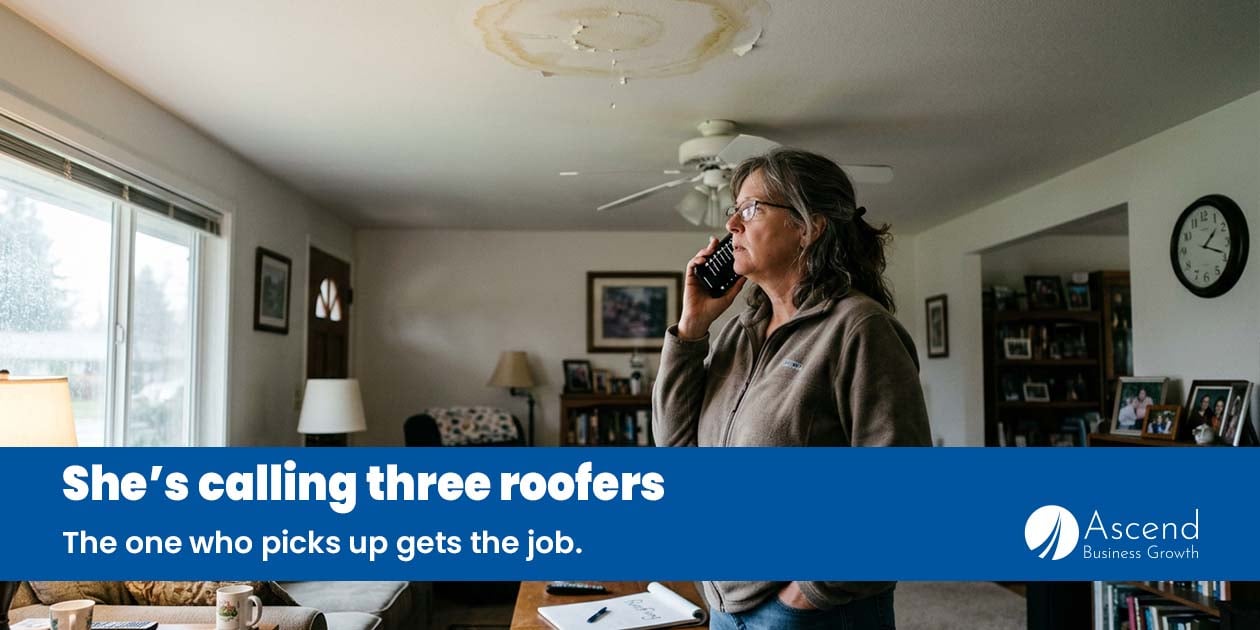
It's 4:10 PM on a Friday afternoon. A homeowner notices a brown ring on the ceiling that wasn't there last week. It's supposed to rain Sunday.
She looks up three roofing companies. She fills out a form on the first one, calls the second and gets voicemail, and calls the third.
Somebody at the third company picks up.
By Monday morning, when your office opens and sees the form submission from Friday, she already has an inspection scheduled. Nobody at your company did anything wrong. You just weren't there.
That's a revenue leak, and it's the one that costs you a homeowner you never got to meet.
What's missing is lead response time — how long it actually takes for a real person at your company to reach a homeowner who contacted you, measured from the moment they reached out rather than from the moment somebody noticed.
Almost no roofing owner knows their lead response time. Most guess low, and they're usually off by hours.
This article covers why roofing is an urgency category where voicemail loses jobs, why the gap usually isn't anyone's fault, what slow response costs, and how to measure your own lead response time this week.
Table of Contents
- Key takeaways
- Why does response time matter more in roofing than in most businesses?
- Why nobody is available to respond — and why that isn't laziness
- Why you don't know your real lead response time
- Does an automatic text count as a response?
- What does slow lead response time cost a roofing company?
- How to measure your own lead response time
- What does good roofing lead response look like?
- How does lead response time fit into the bigger revenue picture?
- Find your roofing revenue leaks
- Roofing lead response time FAQs
Key takeaways
- Roofing is an urgency category. A homeowner with active water damage will not wait for a callback, and voicemail usually means they call the next company.
- Measure lead response time from when the homeowner reached out, not when someone at your company noticed.
- The gap usually isn't laziness. The people capable of responding are on roofs during exactly the hours leads arrive.
- An automatic text is a placeholder, not a response. It buys you a little time and nothing else.
- You can measure your own lead response time this week by submitting your own form at three different times and writing down what happens.
Why does response time matter more in roofing than in most businesses?
Because the homeowner's problem is often getting worse while they wait, and because they're working down a list.
Plenty of businesses can take a day to respond without consequence. If somebody emails me about consulting work, getting back to them the next morning is normal. Nobody's house is getting damaged in the meantime, and the buyer isn't in a hurry either.
Roofing doesn't work that way. A homeowner contacting a roofing company is usually in one of three states.
- Something is leaking right now. That's an emergency, and it gets worse every hour it rains.
- Something has a deadline. A home sale inspection came back bad, an insurance carrier sent a notice, a claim has a filing window. Not an emergency, but the clock is real and it isn't yours.
- Something finally prompted them to look into it. A storm rolled through, a neighbor got a new roof, they've been putting it off for two years, and today they didn't.
The first two won't wait. The third might. And all three arrive through the same form, so you can't tell them apart from a name and a phone number — which means in most roofing companies they all wait the same ninety minutes. Only one of those homeowners is still available at the end. Telling them apart is a separate problem worth solving.
That's also what makes voicemail expensive here. When a homeowner hears a recording, they aren't evaluating your company. They're deciding whether to leave a message or hang up and try the next number. Most hang up, because waiting for a stranger to call back at an unknown time is a bad trade when two more roofing companies are one tap away.
Voicemail at a law firm is normal. Voicemail at a roofing company on a rainy Saturday is a homeowner going elsewhere.
Your response time isn't measured against your own standards. It's measured against whichever competitor picked up the phone.
Why nobody is available to respond — and why that isn't laziness
In roofing, the people qualified to respond are physically unavailable during the exact hours leads arrive.
This is the structural piece most advice about response time ignores. Nobody at a roofing company is sitting by a screen waiting for a form submission. Your estimator is on a roof. Your owner is on a roof. The office manager is handling a supplier problem and two homeowners who are already customers.
Leads arrive between 8 am and 5 pm. That's the same window when your team is least able to answer.
So the honest version of the problem isn't "we should respond faster." It's: who is responsible for responding between 7 am and 4 pm, and what happens when that person is unavailable?
Most roofing companies have never answered that question explicitly. Response happens when somebody happens to notice, which means it happens fast on a quiet day and not at all on a busy one. And busy days produce the most leads.
The fix isn't heroics. It's deciding in advance who owns the hour, and what the backup is when they can't.
Why you don't know your real lead response time
Because you remember the fast ones.
Ask a roofing owner how quickly his company responds to a web lead, and you'll usually get a confident answer. Twenty minutes. Same day for sure. We're good about that.
That answer is drawn from the times he personally saw it happen, which are disproportionately the times it went well. Nobody remembers the lead that sat until Monday, because nobody ever knew it existed.
There are two numbers here, and most companies track neither:
- Time to first touch — when anything at all happened, including an automated message.
- Time to a human — when a real person at your company actually spoke with the homeowner.
The second one decides whether you get the job, and it's almost always much longer than the first.
It's also the number nobody measures, because measuring it means comparing a timestamp on the form to a timestamp on a phone call, and in most roofing companies those two things live in different places. That's the same gap that makes most business numbers impossible to produce without somebody assembling them by hand.
Does an automatic text count as a response?
It counts as an acknowledgment, not a response. It's worth having, but it is not what wins the job.
An automatic reply does one useful thing: it tells the homeowner the message arrived and buys you a little patience. That's real value, especially outside business hours.
What it doesn't do is answer the question the homeowner actually has, which is usually some version of "can somebody come look at this, and when?"
The risk is that an auto-reply makes your dashboard look good. Average response time: ninety seconds. Meanwhile, the actual conversation happened four hours later, or never.
Two things make an automatic reply genuinely useful instead of decorative:
- Say when a human will follow up, specifically. "Someone will call you within the hour" is a promise. "We'll be in touch soon" is noise.
- Give an escape hatch for emergencies. If water is actively coming in, tell them what to do right now — a number to call, or a way to flag it as urgent.
And then keep the promise. An auto-text that says someone will call within the hour, followed by nobody calling, is worse than sending nothing. It's also the same promise your form's confirmation page should be making, with the same obligation attached.
What does slow lead response time cost a roofing company?
Everything you spent getting that homeowner to contact you, plus the job.
These are illustrative numbers. Use your own.
Say 40 leads a month come in through your website, your ads and your listings. Suppose 10 of those arrive at a moment when nobody is available to respond quickly — a busy weekday afternoon, an evening, a Saturday.
If four of those ten reach a competitor first and never come back, that's four opportunities a month. At a $12,000 average job and a 30% close rate, that's about 1.2 sold jobs a month, or $14,400 in potential revenue. Over a year, that's about $172,800 in work that may have gone to whoever responded first.
Over a year, that's around $216,000 in work that went to whoever answered.
The money you spent generating those four leads is also gone, and it's the same money whether they converted or not.
What makes this leak frustrating is that it's invisible from inside. There's no record of the homeowner who hung up on your voicemail. No lost deal, no feedback, no complaint. From where you sit, that person never existed.
How to measure your own lead response time
You can find your real number this week. Don't ask your team how fast they respond — they'll tell you what they believe, and they'll be sincere. Test it instead.
Test 1: Submit your own form on a Friday afternoon
Use a name and a phone number nobody at your company recognizes. Fill out your website form around 4 pm on a Friday like a homeowner with a leak.
Write down the exact time. Then wait.
- How long until anything happens at all?
- How long until a human being contacts you?
- What did they say, and did it move you toward an appointment?
Friday at 4 pm is the honest test. Anyone can look good on Tuesday morning.
Test 2: Do it again at three other times
Tuesday at 10 am. Saturday at 9 am. A weekday evening around 7 pm.
Four data points will tell you more about your business than a month of dashboards, because they cover the times your team is least able to respond.
Test 3: Ask three people what they think the number is
Before you show anyone the results, ask your office manager, an estimator and yourself the same question: how long does it take us to respond to a web lead?
Write down all three answers. Then compare them to what actually happened.
The gap between what your team believes and what you measured is the real finding, and it's usually bigger than anyone expects.
Test 4: Find out who owns the hour
Ask a simple question: right now, at 2 pm on a Wednesday, whose job is it to respond to a lead that comes in?
If you get a name, ask what happens when that person is on a roof. If you get "whoever sees it," you've found the problem.
Test 5: Check your last ten leads
Pull the last ten inquiries from any source. For each one, find when it arrived and when someone actually spoke to that person.
If you can't reconstruct that, note it. Not being able to measure response time is its own finding, and it's the reason the number never improves.
Found a response-time gap?
The free Roofing Revenue Leak Check looks for the other places where leads and opportunities may be slipping through your business.
Check your roofing revenue leaks →
What does good roofing lead response look like?
A real person reaches the homeowner quickly, and somebody specific is responsible for making that happen. That's the bar.
Somebody owns the hour. Not a department, not "whoever sees it." A named person is responsible for responding during each block of the day, with a defined backup when they're unavailable.
Urgent gets separated from everything else. A homeowner with active water damage should not sit in the same queue as someone planning next spring. Even a single question on your form can sort them.
An acknowledgment that makes a specific promise. Tell the homeowner when someone will contact them, and use a real time rather than "soon."
Something covers nights and weekends. Whether that's an answering service, a rotating cell phone or a message that clearly explains what happens next, roofing emergencies don't respect business hours.
The number gets measured. Time from inquiry to human conversation, checked monthly. One number, watched consistently, does more than any amount of reminders to move faster.
None of that requires new software. Most roofing companies already have everything they need and have simply never decided who is responsible when.
How does lead response time fit into the bigger revenue picture?
Response is where marketing spend either turns into a conversation or evaporates.
Lead source → Lead capture → Response → Qualification → Appointment → Estimate → Follow-up → Sale → Measurement
Everything before response is you spending money to make a homeowner reach out. Everything after it depends on a conversation actually happening.
That makes this stage a chokepoint. A great website and perfectly routed phone numbers deliver a homeowner to a moment where somebody has to pick up, and if nobody does, none of the upstream work mattered.
It also compounds with the stage after it. A homeowner who waited four hours for a callback starts the relationship already half sold on somebody else, which shows up later as a lower close rate that looks like a sales problem and isn't.
This is one of fifteen revenue leaks that waste good roofing leads, and it's the one where the homeowner disappears without leaving a trace.
Find your roofing revenue leaks
You may not need more leads. You may need to find out what's happening to the ones already trying to reach you.
The free Roofing Revenue Leak Check looks across your lead-to-revenue process to find where opportunities may be slipping through — from how homeowners find and contact you through response, appointments, estimates, follow-up, sales and measurement.
We start with one short call. Then I look at what's public and, where it helps, what's happening inside your process. You get a plain-English list of what may be leaking, roughly what it may be costing you, and what I'd fix first. If nothing's leaking, you'll know that for certain instead of guessing. No pitch buried inside it.
Check your roofing revenue leaks →
Roofing lead response time FAQs
What is lead response time?
Lead response time is how long it takes for someone at your company to reach a prospect after they contact you, measured from the moment they reached out rather than from when your team noticed. In roofing, the number that matters is time to a human conversation, not time to an automated acknowledgment.
How fast should a roofing company respond to a lead?
Fast enough that the homeowner hasn't already reached a competitor, which in practice means minutes for anyone with an active leak. For homeowners planning ahead, speed matters far less than making a clear promise and keeping it. The useful goal isn't a single target for everyone; it's separating the urgent inquiries from the rest.
Is it bad for a roofing company to send calls to voicemail?
In an urgency category like roofing, voicemail usually means the homeowner calls the next company rather than waiting. Voicemail isn't automatically a failure, but a box nobody checks for a day or two functions the same as a number that doesn't work.
Does an automatic text reply count as responding to a lead?
It counts as an acknowledgment. It tells the homeowner the message arrived and buys a little patience, which is worth having. It doesn't answer their actual question, and it can make your reported response time look far better than the time it took an actual person to call.
How do you measure roofing lead response time?
Submit your own form using a name and number nobody recognizes, note the exact time, and record how long until a real person contacts you. Do it at four different times, including a Friday afternoon and a Saturday morning. Four tests will tell you more than any dashboard, because they cover the hours your team is least able to respond.


Comments