
Your customer will never be happier than the day the roof is finished. Here's what most roofing companies fail to collect before that window closes.
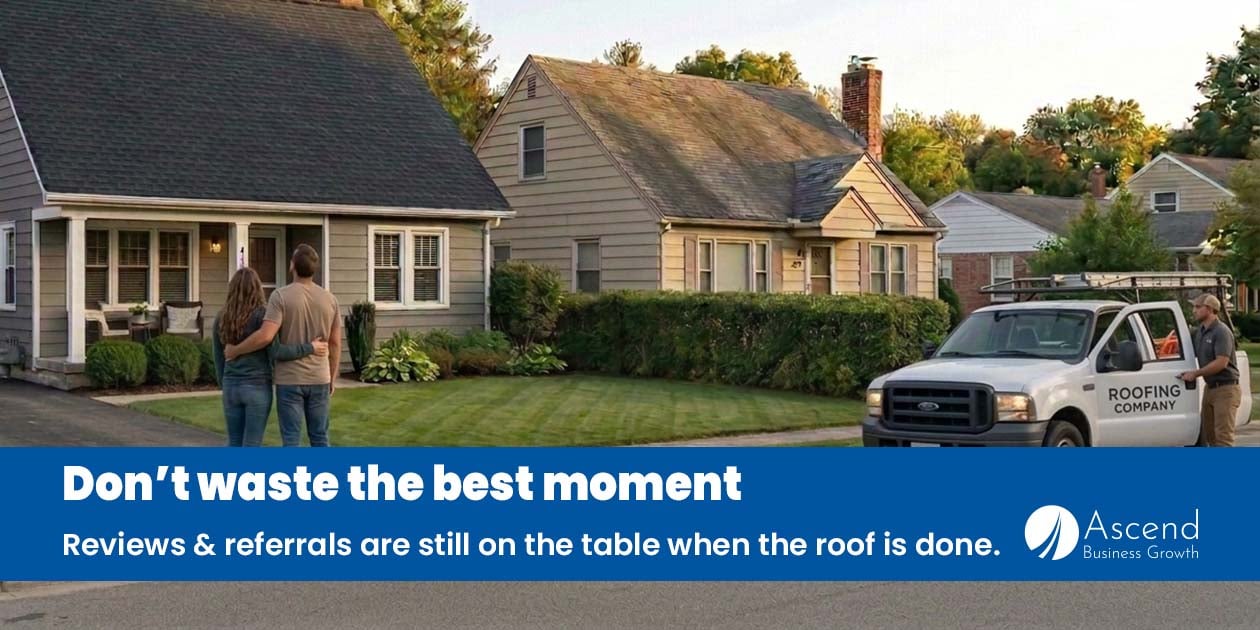
The crew finishes on a Thursday. The homeowner comes out, stands in the driveway, looks up at her new roof, and is genuinely delighted.
This is the best she will ever feel about your company.
By Saturday, she's thinking about something else. In two weeks, she'd struggle to remember your company name without looking at the invoice. In two months, when her coworker mentions needing a roof, she'll say, "We used somebody, they were good, I can look it up."
Nobody asked her for a review. Nobody photographed the finished job. Nobody asked whether any of her neighbors had mentioned their own roofs. Nobody asked if she knew anybody.
That's a revenue leak, and it's the last one in the job — the moment where everything the customer is still worth either gets collected or evaporates.
What's missing is a close-out — a defined set of things that happen when a roof is finished, while the customer is still delighted and the crew is still on the street.
Here's what makes roofing different. She's not buying another roof for twenty-five years. There is no repeat purchase to nurture. Everything that customer is still worth to you is a review, a referral, a photo, and a neighborhood, and all four have a shelf life of about a week.
This article covers why the window closes so fast, what should happen at the final walkthrough, what to track, and how to check what your company currently does when a job ends.
Table of Contents
- Key takeaways
- Why the end of a roofing job is different
- How fast the window closes
- The final walkthrough is the whole thing
- Asking for the review
- Asking for the referral, specifically
- The neighbors are still watching
- The photos have four jobs
- Surveys, and what they're actually for
- What to track after the job
- What does a missing close-out cost?
- How to check your own close-out
- What does a good roofing close-out look like?
- How the close-out fits into the bigger revenue picture
- Find your roofing revenue leaks
- Roofing reviews and referrals FAQs
Key takeaways
- A roofing customer isn't buying again for decades, so their remaining value is entirely reviews, referrals, photos, and neighbors.
- All four of those expire quickly. The day the job finishes is the peak, and it declines fast from there.
- A final walkthrough by the person who sold the job is the single highest-leverage habit in this article.
- "If you know anyone who needs a roof" produces almost nothing. Specific asks produce referrals.
- None of this happens by itself, because after the invoice is paid, the job is finished as far as everyone in the company is concerned.
Why the end of a roofing job is different
Most businesses close out a sale hoping for another one. Roofing doesn't get that.
A restaurant wants you back next month. A dentist wants you back in six months. A landscaper wants you every season.
You just installed something that will outlast the homeowner's car, possibly their marriage, and quite likely their ownership of that house. Unless they own rental property or a business, you will probably never sell them anything again.
That changes what the end of the job is for. It isn't relationship maintenance for future purchases. It's the only chance to collect what this customer can still produce:
- A review, which affects whether strangers call you
- A referral, which is the cheapest job you'll ever sell
- Photos of finished work, which is your proof for everyone else
- A neighborhood that just watched your crew work for two days
Those four things are the actual remaining value of the customer. And unlike a relationship you can nurture for years, they're perishable.
How fast the window closes
The day the job finishes is the peak, and the decline starts immediately.
On finish day, the homeowner is looking at a visible improvement to her house that she chose and paid a lot of money for. She's relieved it's done, pleased with how it looks, and feeling good about the decision.
A week later, it's just her roof. She's stopped noticing it. The money is a memory, and so is the inconvenience.
A month later, asking for a review feels to her like being asked to do homework for a transaction she considers closed. She'll say yes and not do it, which is worse than not asking.
The neighbors are on an even shorter clock. They watched a crew work, they thought about their own roof for a day or two, and then life resumed.
This is why close-out has to be structural rather than intentional. Anything that depends on someone remembering to circle back next week will happen sometimes, and sometimes is not enough for a thing this valuable.
The final walkthrough is the whole thing
The single highest-value habit in this article is the person who sold the job coming back to see it finished.
Not the crew lead. The estimator, or the owner if he sold it. The person the homeowner talked to at the kitchen table.
It takes twenty minutes, and it accomplishes six things at once:
- You confirm she's actually happy, in person, where she'll tell you the truth
- You catch the small complaint before it becomes a review
- You take the photos
- You ask for the review while she's standing there looking at the roof
- You ask about neighbors, and about anyone else she knows
- You close the loop on anything promised at the estimate
That fourth item is the one that matters most. A review request that comes from a person she knows, standing in front of the finished work, converts at a completely different rate than an automated text two days later.
The catch-the-complaint part is underrated, too. A homeowner with a small issue who is asked in person will usually just tell you, and you can fix it. The same homeowner, not asked, sits with it for a week and writes about it.
It's also worth noticing who this puts back in front of the customer: the person whose income depends on selling more roofs, in a neighborhood where a crew has just spent two days.
Asking for the review
Most roofing companies get a fraction of the reviews they could because asking is left to chance.
Reviews do two jobs. They affect whether your company shows up when someone searches nearby, and they're what a homeowner reads before deciding to call. That makes them one of the highest-return things a roofing business can accumulate, and one of the hardest for a competitor to copy quickly.
What actually works is unglamorous:
Ask in person, at the walkthrough. "Would you mind leaving us a review? It genuinely helps." That's it.
Make it one tap. Send the direct link by text while you're standing there. Not a link to your website with instructions. The review form itself.
Ask once more, a few days later. A single short follow-up text. Not a campaign.
Respond to every one. Including the bad ones, calmly. Everyone considering you is reading how you handle criticism.
What doesn't work: waiting until the invoice clears, asking by email a week later, or asking everyone at once every few months when somebody notices the review count is low.
One more thing worth being clear on. Ask everyone, not just the customers you're confident about. Filtering who you ask is against the rules of most review platforms, and a page of nothing but perfect reviews reads as suspicious anyway.
Asking for the referral, specifically
"Let us know if you know anyone who needs a roof" produces almost nothing because it asks the customer to do the work of thinking.
She's not going to inventory her acquaintances on your behalf. She'll say "sure, absolutely," mean it, and never think about it again.
Specific questions produce actual names:
- "Have any of your neighbors mentioned their roof?"
- "Anybody at work been dealing with storm damage?"
- "Do you know anyone else on this street who's had a roofer out?"
- "Any chance you've got a rental or another property?"
Those are answerable. A person can search their memory for a specific thing far more easily than for a category.
A formal referral program — a gift card, a discount, a donation to a charity — helps, but less than people expect. The asking is what produces referrals. The incentive mostly affects whether they follow through.
And whatever comes out of that conversation has to go somewhere. A name mentioned in a driveway that nobody writes down is the same as no name at all, which is the same problem as the maybes from a canvassing day.
The neighbors are still watching
For two days, everyone on that street watched a roofing crew work. The finished job is the best advertisement you'll ever have, and it's temporary.
Those neighbors have houses built around the same time, with roofs around the same age, and they can now see what a new one looks like from their own driveway. They also have a completely low-risk way to check you out: ask the neighbor.
The close-out is when to act on that, while the work is visible and recent.
Three things, in order of effort:
The sign stays up. Obvious, frequently forgotten, free.
Somebody knocks the street. Not a pitch — "We just finished the roof at number 14, wanted to let you know we're in the neighborhood." Most say no. A few say their roof is getting old.
The job gets posted, and the area gets targeted. A post about the finished job, and if you run ads, a small spend aimed at that specific neighborhood for a week or two.
Whatever comes back from the knocking needs the same thing every other conversation needs: a place to land, including the people who say not this year. Those are the most valuable outputs of the day and the most likely to be forgotten by Monday.
The photos have four jobs
Sixty seconds of photography at the end of a job feeds four different things, and most roofing companies produce none of them.
The same set of pictures becomes:
- A social post showing recent work in a named neighborhood
- Photos on your business listing, which affect how you show up in local searches
- Portfolio material that an estimator can show at the next kitchen table
- Proof for a homeowner comparing you to two other companies
What to capture: the finished roof from the street, a detail shot or two, anything that came out particularly well, and if you have them, the before pictures from the estimate.
Phone photos are fine. Nobody is judging the photography. They're checking whether you've done work like theirs, nearby, recently.
The reason this doesn't happen isn't difficulty. It's that it belongs to nobody. The crew's job is the roof, the estimator has moved on, and the office is scheduling. Sixty seconds of work that nobody owns doesn't happen, which makes this an assignment problem rather than an effort problem.
Surveys, and what they're actually for
A survey is not how you find out whether the customer is happy. The walkthrough is. The survey is how you find out whether your process is working across many jobs.
Those are different questions, and they get confused constantly.
If you want to know how this particular customer feels, ask her, in person, at the end of the job. She'll tell you, and you can act on it immediately.
A short survey does something else: it accumulates. Twenty responses over a quarter show you patterns no single conversation reveals — that customers consistently mention not knowing when the crew would arrive, or that cleanup gets praised, or that one estimator's jobs come back differently than another's.
Keep it genuinely short. Three or four questions. Did we do what we said we'd do, how was the communication, would you recommend us, anything we should have done differently.
And read them. A survey nobody reviews is a slightly rude way to end a relationship.
What to track after the job
If the close-out isn't tracked, it becomes the first thing dropped in a busy month, and nobody will notice for a year.
Four numbers are enough:
- Walkthroughs completed as a percentage of finished jobs
- Reviews received per month, and per finished job
- Referrals named — how many people were actually mentioned, not how many closed
- Jobs photographed as a percentage of finished jobs
Each one is a percentage of completed jobs, which makes them comparable month to month regardless of volume.
The reason to track the inputs rather than the outcomes is that the inputs are the part you control. Referrals that close are a lagging number you can't do much about. Referrals asked for are a habit, and habits respond to being measured.
What does a missing close-out cost?
The cheapest jobs you'll ever sell, and the proof you'd use to sell everything else.
These are illustrative numbers. Use your own.
Say you finish 150 jobs a year and currently ask for referrals inconsistently.
If a consistent close-out produced one named referral for every ten jobs, that's 15 names. At a 50% close rate, roughly 7 jobs. At $12,000 each, about $84,000 in work that cost you nothing to generate — no ads, no lead fees, no cold calls.
Now reviews. Most roofing companies collect a handful a year. Asking in person, at the right moment, on every job, commonly moves that to a review on a meaningful share of jobs. That affects whether you appear when strangers search, which affects everything upstream.
And the photos. 150 jobs a year, unphotographed, is 150 pieces of proof you paid to create and discarded.
The total cost of collecting all of it is about twenty minutes per job from the person who sold it.
How to check your own close-out
About 10 minutes, and the first test tells you most of it.
Test 1: Ask what happens when a job finishes
Ask your estimator and your office manager separately: walk me through everything that happens after a crew finishes a roof.
If both answers end at the invoice, you have your finding.
Test 2: Count last month's reviews against last month's jobs
How many roofs did you finish, and how many reviews came in?
The ratio is the number. Most roofing companies find it's under one in ten, and most are surprised.
Test 3: Pick three finished jobs and look for the photos
Three jobs from last month. Are there photos of the finished work anywhere — a post, your listing, a folder?
Test 4: Call a customer from two months ago
Ask how the roof is doing and whether they've been happy. Then ask if they know anyone who might need one.
Notice two things: what she says about the job, and how the referral question feels this long after. That's the window, measured.
Test 5: Find out where a referral would go
Ask this: if a customer gave your estimator a neighbor's name in a driveway tomorrow, where would that name end up?
If the answer is his phone or a pause, you've found where the cheapest leads in your business go.
Found a close-out gap?
The free Roofing Revenue Leak Check looks for the other places where reviews, referrals and future opportunities may be slipping through your business.
Check your roofing revenue leaks →
What does a good roofing close-out look like?
The same six things happen on every finished job, and somebody's name is attached to each one.
The person who sold it comes back. Within a couple of days, in person, for twenty minutes.
Photos get taken. Finished roof, a detail or two, paired with the before shots from the estimate.
The review gets asked for in person, with a link sent on the spot. One short follow-up a few days later, then stop.
The referral question is specific. Neighbors, coworkers, other properties. And whatever comes back gets written down where somebody will work it.
The neighborhood gets worked while the job is visible. The sign stays up, somebody knocks the street, the job gets posted.
Four numbers get tracked monthly. Walkthroughs, reviews, referrals named, and jobs photographed — each as a percentage of finished jobs.
None of this requires software or a budget. It requires deciding that the job isn't finished when the invoice is paid.
How the close-out fits into the bigger revenue picture
This is the end of one cycle and the raw material for the next one.
Lead source → Lead capture → Response → Qualification → Appointment → Estimate → Follow-up → Sale → Measurement
Everything in this series before the sale is about winning work. The handoff, the schedule and the materials are about keeping the margin on work you won.
The close-out is different again. It's the only stage that produces new lead sources rather than consuming them — referrals, reviews, proof, and a neighborhood that just watched you work.
Which means a company with no close-out is buying every single lead it gets, forever, while the cheapest source of future work drives away in the trailer every Thursday.
It also compounds in the other direction. Reviews affect whether strangers find you. Photos affect whether they choose you. Referrals arrive already trusting you and close faster at better margin. Skip the close-out, and you're not just losing referrals — you're raising what every other lead costs.
This is one of fifteen revenue leaks that waste good roofing leads, and it's the one where you'd already done everything right.
Find your roofing revenue leaks
You may not need more leads. You may need to collect the ones your finished work is already producing.
The free Roofing Revenue Leak Check looks across your lead-to-revenue process to find where opportunities may be slipping through — from how homeowners find and contact you through response, appointments, estimates, follow-up, sales, and measurement.
We start with one short call. Then I look at what's public and, where it helps, what's happening inside your process. You get a plain-English list of what may be leaking, roughly what it may be costing you, and what I'd fix first. If nothing's leaking, you'll know that for certain instead of guessing. No pitch buried inside it.
Check your roofing revenue leaks →
Roofing reviews and referrals FAQs
When should a roofing company ask for a review?
In person, at the end of the job, while the homeowner is looking at the finished roof. That's the peak of how they'll feel about your company, and it declines quickly from there. Send the direct review link by text while you're standing there, and follow up once a few days later.
How can a roofing company get more reviews?
Ask every customer, in person, at a consistent moment, and make leaving one a single tap. Most roofing companies get a fraction of the reviews available to them simply because asking is left to whoever remembers. Don't filter who you ask based on how you think they'll respond — that's against most platforms' rules, and a page of flawless reviews reads as suspicious anyway.
How do you ask a roofing customer for a referral?
Specifically. "Let us know if you know anyone" asks the customer to do the thinking and produces almost nothing. "Have any of your neighbors mentioned their roof?" is a question someone can actually answer. Then write down whatever comes back, because a name mentioned in a driveway and not recorded is the same as no name.
Do roofing referral programs work?
They help, but less than most owners expect. The asking is what produces referrals; the incentive mainly affects follow-through. A company with no referral program that asks specific questions on every job will out-refer a company with a generous program that never brings it up.
Should the salesperson return after a roofing job is finished?
Yes, and it's the highest-return twenty minutes in the whole process. The person who sold the job confirms the homeowner is happy, catches small problems before they become reviews, takes the photos, asks for the review in person, and asks about neighbors — all at the moment the customer is most willing to help.


Comments