
Every roof you finish is proof you could show, and most roofing companies throw it away. Here's what roofing social media is actually for.
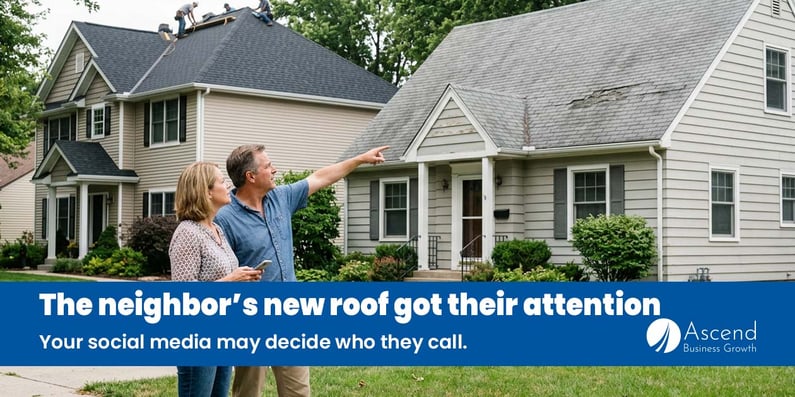
A crew finishes a tear-off and replacement on a Thursday afternoon. Clean job, good weather, new roof on a house that badly needed one.
They sweep the driveway, run the magnet over the lawn, load the trailer and drive away.
Nobody took a photo.
Meanwhile, about twenty households on that street watched a roofing crew work all day. Several of them have a roof about the same age as the one that just came off. At least one of them said something to their spouse that evening about maybe needing to look into that.
None of them know your company's name.
That's a revenue leak, and it's an unusual one because nothing was lost. You did the work, got paid, and the customer is happy. You just generated something valuable and threw it away.
What's missing is roofing social media — using the work you already do as proof, in the places your next customer is already looking. Not brand building. Not a content calendar. Proof.
Here's the size of it. A company doing 150 jobs a year is working in front of roughly 3,000 households. Photographing a finished job takes about sixty seconds.
This article covers what roofing social media is actually for, why the neighbors around your current job are your best audience, the platform almost no roofing company with crews is using, and how to check what you're currently doing with all this.
Table of Contents
- Key takeaways
- What is roofing social media actually for?
- Every job you finish is proof you're throwing away
- Why the twenty houses around your job are your best audience
- Nextdoor: the platform solo roofers use, and companies don't
- What should a roofing company actually post?
- Why consistency beats quality
- Does community involvement actually produce work?
- How roofing social media feeds your search visibility
- What does weak roofing social media cost you?
- How to check your own roofing social media
- What does good roofing social media look like?
- How does social media fit into the bigger revenue picture?
- Find your roofing revenue leaks
- Roofing social media FAQs
Key takeaways
- Roofing social media isn't brand building. It's showing proof of work to people who live near the work.
- Every completed job produces photos, a review opportunity and a neighborhood signal, and most roofing companies capture none of it.
- Nextdoor is where neighbors ask each other for contractor recommendations, and solo operators use it heavily while companies with crews mostly don't.
- Your company may already have a Nextdoor page you've never claimed, with recommendations on it you've never seen.
- Consistency matters more than production quality. A phone photo posted every week beats a polished video every quarter.
What is roofing social media actually for?
For a roofing company, social media has three jobs: proving you do good work, being findable in the neighborhoods you serve, and giving people something to point at when they recommend you.
That's a narrower purpose than most advice assumes, and the narrowness is useful.
You are not trying to build an audience. Nobody follows roofing companies for entertainment. You're not going to go viral, and if you did, it wouldn't sell a roof.
What you're doing is much simpler. When a homeowner three streets over is deciding whether to call you, they'll look you up. What they find should be a company that's visibly been working nearby, recently, and did good work.
That's it. Everything else — posting schedules, engagement, follower counts — is noise borrowed from businesses that sell something people buy more than twice in their life.
Every job you finish is proof you're throwing away
A completed roof generates four things at once, and most roofing companies capture none of them.
Think about what exists for about two hours at the end of a job, before the crew drives away:
- Photos. Before and after, the tear-off, the decking repair nobody knew about, the finished roof in good light.
- A happy customer, at the moment they're most willing to say something nice about you.
- A neighborhood that just watched your crew work and is paying attention.
- A story — the rotten sheathing under a valley, the third layer nobody expected, the repair that saved the homeowner a full replacement.
All four are free. All four expire fast. And all four are the raw material for everything else you'd want to do with marketing.
The reason they get thrown away isn't laziness. It's that nobody's job includes it. The crew's job is the roof. The estimator has already moved on to Friday's appointments. The office is handling scheduling. Capturing the job is nobody's responsibility, so it doesn't happen.
Which means it's not a motivation problem. It's an assignment problem, and it's solved by making it one person's job with thirty seconds of their time per house. The same twenty minutes that captures all four is the close-out most roofing companies skip entirely.
Why the twenty houses around your job are your best audience
The highest-intent audience a roofing company will ever reach is the people who live around a roof you're currently replacing.
Consider what's true about them that isn't true of anyone else you could market to.
Their houses were often built around the same time, which means their roofs are around the same age. They just watched a full day of work happen, so the job is on their mind. They can see the result from their own driveway. And they have an obvious, non-awkward way to evaluate you: ask the neighbor.
Now think about how most roofing companies reach those twenty households. A yard sign, if they remembered to put one out.
There are at least four ways to be in front of those people while the job is happening, and most companies use one:
- The yard sign and the truck in the driveway
- A knock on the door, before or after the job, not during
- A post about the job, visible to that neighborhood
- Paid ads targeted to that specific area while the work is fresh
Three of the four are free and one takes sixty seconds. The paid version is worth a separate conversation, and I covered it in why more roofing ads can mean more wasted money — a small spend aimed at one neighborhood for one week is very different from a general campaign.
Whatever comes back from a door knock needs somewhere to land, including the homeowners who say not this year. Those are the most valuable output of the day and the most likely to be forgotten by Monday.
Nextdoor: the platform solo roofers use, and companies don't
Nextdoor is where neighbors ask each other who to call, and it's the biggest gap I see between solo roofers and companies with crews.
Watch the pattern in almost any market. The one-truck operator is on Nextdoor constantly — answering questions, posting jobs, collecting recommendations — because it's free lead generation and he's the whole marketing department. The company doing 150 roofs a year with three crews often isn't there at all, because it was nobody's job.
That's backward. The bigger company has more finished work to show, more customers to ask, and more neighborhoods it's worked in.
A few things about how Nextdoor actually works that matter for a roofing company:
Recommendations are the currency. Nextdoor says local business recommendations make up roughly 30% of everything on the platform. Neighbors ask who to call, and other neighbors answer. Those answers attach to a business page.
Recommendations affect where you appear. Within a category, businesses are listed by how many recommendations they have. More recommendations, higher placement, in front of exactly the people who are asking.
They come from verified neighbors. That's different from an anonymous review. It's a person nearby, with a real address, vouching for you by name.
Your page may already exist. Pages can be generated from public information or created when a neighbor mentions a business that isn't listed. So there may be a page for your company right now, possibly with recommendations on it, that nobody at your company has ever logged into.
Claiming it is free and takes about as long as this article.
One caution. Nextdoor is a neighborhood, not a billboard. A company that shows up only to advertise gets ignored or worse, and the whole zip code is watching when somebody complains. The companies that do well there answer questions, post their own work plainly, and don't pitch.
What should a roofing company actually post?
The work, and the things only someone who does the work would know.
What performs, in roughly this order:
- Finished jobs, by neighborhood. "Tear-off and replacement on the east side this week" with three photos. Name the area, not the address.
- The thing under the shingles. Rotten decking, a valley done wrong by the last guy, three layers where there should have been one. Homeowners find this genuinely interesting, and it demonstrates expertise without claiming any.
- Crews working. Real people, real equipment, real weather.
- Answers to questions you get asked constantly. How long does a roof last around here, what does hail damage look like, do I need a full replacement.
- Storm response. When weather hits, be visibly present and useful before you're promotional.
What nobody cares about: inspirational quotes, holiday graphics, "we're hiring" as your only post in six weeks, stock photos of roofs that aren't yours, and anything that reads like it was written by a marketing department.
One rule worth holding: a homeowner should be able to look at your page and tell you worked in their area recently. That's the whole test.
Why consistency beats quality
A phone photo posted every week is worth more than a professional video posted every quarter.
Most roofing companies do social media in bursts. Somebody gets motivated, posts five times in a week, then nothing for two months. The page ends up looking abandoned, which is worse than not having one — a homeowner who finds a page whose last post is from last October now has a reason to wonder about you.
The fix isn't more effort. It's less effort attached to something that already happens.
Tie posting to job completion rather than to a calendar. You finish roofs continuously, so if every finished job produces one post, you have a rhythm that doesn't depend on anyone feeling inspired.
Make it somebody's actual job. A crew lead who takes three photos before loading up, sent to one place. Ten seconds. Then one person — office manager, owner's kid, whoever — posts them.
Quality is a distraction here. Homeowners aren't judging your photography. They're checking whether you're real and whether you've been working nearby.
Does community involvement actually produce work?
Yes, but not the way it's usually described, and not quickly.
You'll see roofing companies sponsoring ball teams, doing free roofs for veterans, showing up after storms with supplies. The cynical read is that it's marketing dressed as charity. The naive read is that good deeds get rewarded.
The accurate read is narrower: it makes you a name people already know before they need a roof.
That matters because of how the buying decision actually happens. A homeowner with a leak isn't evaluating six companies on the merits. They're asking who they've heard of, and who their neighbor mentions. Being a familiar name moves you from "a roofing company" to "the roofing company that did the thing at the school."
Two honest caveats.
It's slow. This is a multi-year effect, not a campaign, and any roofer promising you leads from a sponsorship this quarter is selling something.
And it has to be real. Communities are small, and people can tell the difference between a business that shows up and a business that shows up with a photographer. The photo is fine. The photo being the point is not.
How roofing social media feeds your search visibility
The same activity that makes you visible to neighbors also makes you easier for search engines and AI assistants to recommend.
The connection is more direct than it looks. Photos of recent local jobs can go on your Google Business Profile as easily as anywhere else. Customers who just said something nice on a neighborhood platform are the customers most likely to leave a review. Mentions of your business in local conversation are a signal that you're a real, active company in a specific place.
I wrote in the article on roofing SEO gaps that cost you local organic leads that the systems deciding whether to show your company favor businesses whose information is consistent and whose activity is visible. Social is one of the places that activity shows up.
That's why the effort compounds. One set of photos from a finished job can be a post, a profile update, a review request and a portfolio entry. The sixty seconds gets spent once.
What does weak roofing social media cost you?
It costs you the cheapest work you'll ever get — jobs that come from people who already saw you working nearby.
These are illustrative numbers. Use your own.
Say you complete 150 jobs a year. If each one is watched by roughly 20 nearby households, that's around 3,000 homeowners a year who saw your crew work and have no particular reason to remember your name.
If capturing and posting that work produced even four additional jobs a year — a little over one in a thousand of those households — that's about $48,000 at a $12,000 average.
The cost of producing it is three photos per job and somebody spending twenty minutes a week.
Compare that to what four additional jobs would cost through paid advertising, and the comparison isn't close. This is the cheapest lead source available to a roofing company, and it's the one most likely to be nobody's responsibility.
How to check your own roofing social media
You can find out where you stand in about 10 minutes.
Test 1: Look up your own Nextdoor page
Search for your company on Nextdoor. Not your personal feed — your business.
- Does a page exist?
- Has anyone claimed it?
- Are there recommendations on it you've never seen?
- Is the phone number right?
Plenty of roofing owners find a page they didn't know about. Some find recommendations nobody ever responded to.
Test 2: Check your last post date
Open every social account your company has and note the date of the most recent post.
If any of them are more than a month old, look at them the way a homeowner would. A page that stopped in the spring reads as a company that might not be around anymore.
Test 3: Count how many of last month's jobs you can see
How many roofs did you complete last month? Now count how many of them appear anywhere — a post, your website, your Google profile.
The gap between those two numbers is what you're throwing away.
Test 4: Ask a crew lead for photos from this week
Just ask. See what comes back and how long it takes.
If the answer is "I didn't take any," that's not a failing on his part. It's confirmation that nobody ever asked him to.
Test 5: Look yourself up the way a neighbor would
Search your company name and look at what a stranger sees across Google, Facebook and Nextdoor together.
Would you be able to tell this company has worked in your neighborhood recently? That's the only question that matters here.
Found a social media gap?
The free Roofing Revenue Leak Check looks for the other places where visibility, leads and opportunities may be slipping through your business.
Check your roofing revenue leaks →
What does good roofing social media look like?
Somebody who's thinking about their roof can find recent proof that you've done good work near them. That's the bar.
A claimed Nextdoor page with recommendations coming in. Free, and the single biggest opportunity most roofing companies with crews are ignoring.
Every finished job produces three photos. One person's responsibility, ten seconds, sent to one place.
A post rhythm tied to the work, not to a calendar. You finish roofs continuously, so post continuously. Weekly is plenty.
The neighborhood named in the post. "Replacement on the west side this week" tells a homeowner something. "Another happy customer" tells them nothing.
Somebody responds. To comments, to questions, to recommendations, to complaints. Especially complaints, calmly, because everyone nearby is reading.
The review ask happens at the same moment. The day the job finishes is when a customer is most willing to say something nice. That's the same moment the photos get taken.
None of this requires an agency, a content calendar or a videographer. It requires deciding whose job it is.
How does social media fit into the bigger revenue picture?
This leak sits at the very front of the process and at the very end of it at the same time.
Lead source → Lead capture → Response → Qualification → Appointment → Estimate → Follow-up → Sale → Measurement
Most of the leaks in this series happen between a homeowner contacting you and a job getting sold. This one happens after the sale is complete, and it feeds the beginning of the process for the next customer.
A finished job is the end of one cycle and the raw material for the next. When nobody captures it, the company keeps buying new leads while the cheapest source of future work drives away in the trailer.
That's what makes it a genuine leak rather than a missed marketing opportunity. The asset was created, at real cost, and discarded.
This is one of fifteen revenue leaks that waste good roofing leads, and it's the one where you already did the hard part.
Find your roofing revenue leaks
You may not need more leads. You may need to stop throwing away the ones your finished work is already generating.
The free Roofing Revenue Leak Check looks across your lead-to-revenue process to find where opportunities may be slipping through — from how homeowners find and contact you through response, appointments, estimates, follow-up, sales and measurement.
We start with one short call. Then I look at what's public and, where it helps, what's happening inside your process. You get a plain-English list of what may be leaking, roughly what it may be costing you, and what I'd fix first. If nothing's leaking, you'll know that for certain instead of guessing. No pitch buried inside it.
Check your roofing revenue leaks →
Roofing social media FAQs
What social media should a roofing company use?
Start with Facebook and Nextdoor, because both are organized around where people live. Instagram is useful if someone on your team enjoys it, since roofing photographs well. The platform matters less than posting your actual finished work in the neighborhoods you serve, consistently enough that a homeowner can tell you were there recently.
Is Nextdoor worth it for roofing companies?
It's worth claiming your business page regardless, because it's free and your page may already exist from public data or a neighbor's mention. Nextdoor is built around neighbors asking each other for recommendations, and businesses within a category are listed in order of how many recommendations they have. Solo roofers use it heavily. Companies with crews often don't, which is the opportunity.
How often should a roofing company post?
Weekly is plenty, and tying posts to finished jobs works better than a calendar. You complete roofs continuously, so let that set the rhythm. What hurts is the burst-then-silence pattern, because a page whose last post is six months old makes a homeowner wonder whether you're still in business.
What should roofing companies post on social media?
Finished jobs with the neighborhood named, what you found under the shingles, crews working, and plain answers to questions homeowners ask constantly. Skip inspirational quotes, stock photos and holiday graphics. A homeowner should be able to look at your page and tell you've worked near them recently.
Does sponsoring local events help a roofing company get work?
Over time, yes, but not as a campaign with measurable leads this quarter. What it buys is familiarity, so that when a homeowner has a problem and asks around, your name is one they've already heard. It works when the involvement is real and stops working when the photo is obviously the point.


Comments