
Roofing leads disappear when call routing breaks quietly — a forwarding rule, an after-hours setting, a number nobody tests. Here's how to check yours.
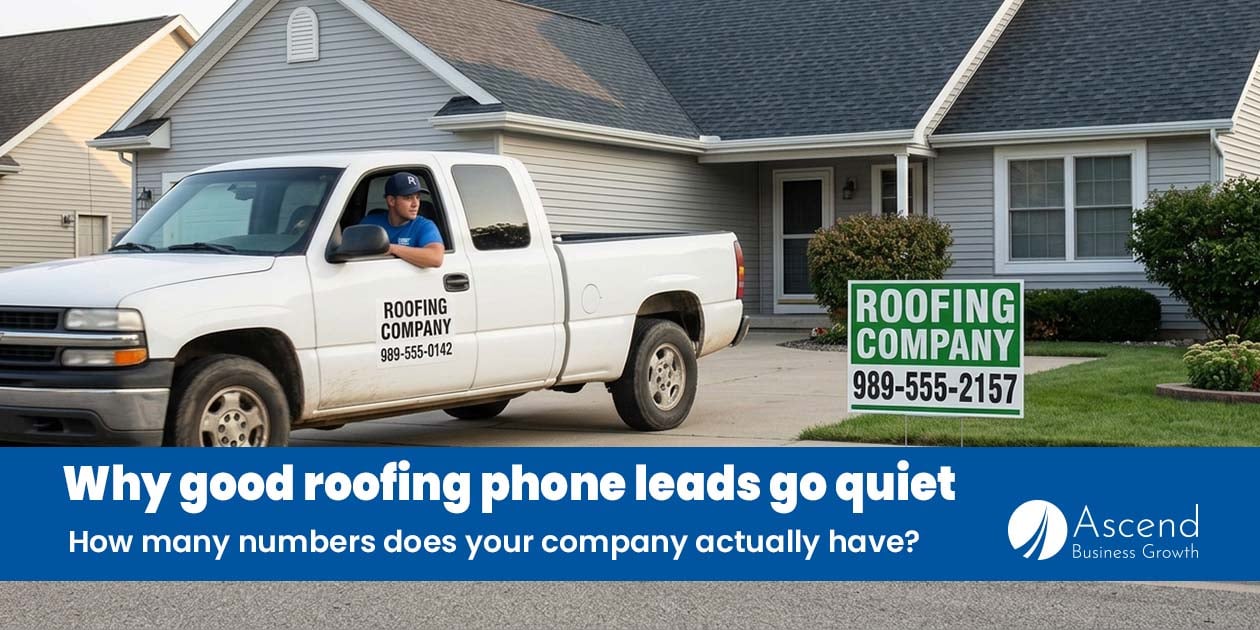
A roofing company was running paid ads. Good ads, real budget — about $6,000 a month going out the door.
The number in those ads just rang. And rang.
Their free Google listing worked fine. Calls came in, someone picked up, jobs got booked. But every call that came through the ad they were paying for went nowhere.
Their team had already heard it from more than one caller: “I tried you a few times before I got through.” Nobody put it together or had time to figure out what was causing it.
That's a revenue leak. Nothing errored out. Nobody complained loudly enough to matter. The phone simply stopped ringing in the right place, and the only people who knew were the homeowners who called somebody else thirty seconds later.
What broke was call routing — what happens to a call after someone dials. Where it goes, who it reaches, and what happens when nobody picks up. Every roofing company has several numbers in circulation and a set of rules deciding where each one lands. Those rules break quietly, and almost nobody tests them.
Here's the size of it. At $6,000 a month in ads producing roughly 30 calls, a number that fails for three weeks means about 22 calls reached nobody. You paid for every one of them.
This article covers what usually breaks in roofing call routing, what those missed calls cost, and how to test every number you own in about ten minutes.
Table of Contents
- Key takeaways
- What is call routing in a roofing business?
- Why do roofing leads disappear before anyone picks up?
- What usually breaks in roofing call routing?
- What happens to calls after hours and during storm season?
- Who actually answers when a homeowner calls?
- What if the call connects but the source doesn't?
- What does bad call routing cost a roofing company?
- How to check your call routing yourself
- What does good roofing call routing look like?
- How does call routing fit into the bigger revenue picture?
- Find your roofing revenue leaks
- Roofing call routing FAQs
Key takeaways
- Most roofing companies have more phone numbers in circulation than they realize, and each one is a separate door that can quietly stop opening.
- Call routing failures do not produce an error. The phone just stops ringing in the right place, and the failure can run for weeks.
- Missed calls hurt twice: you lose the job, and you already spent the money that made the phone ring.
- After-hours rules and storm-season settings are where most of these problems hide, because nobody tests at 7 pm on a Saturday.
- You can test every number you own in about ten minutes with a phone that isn't saved in your company contacts.
What is call routing in a roofing business?
Call routing is the set of rules that decides where a call goes after a homeowner dials. Which line it rings, who it reaches, how long it rings before moving on, and what catches it if nobody answers.
Most roofing owners never think about it as a system, because it wasn't built as one. It accumulated. A tracking number here, a forwarding rule there, an after-hours message somebody recorded four years ago, a cell phone added when a new salesperson started.
That's normal, and it works fine right up until one piece of it changes and nobody notices.
Why do roofing leads disappear before anyone picks up?
Because most roofing businesses have more entry points than they think.
There's the main line. The number on the truck. The one on your yard signs. Your Google Business Profile number, your Local Services Ads number, the tracking number on paid campaigns, and whatever number still lives on a directory listing from 2019 that somebody still finds.
Each one is a door into your business. And each one has its own routing rules, set at a different time, usually by a different person.
If even one of those doors stops opening, leads don't pause and wait for you to notice. They call the next roofer. Those old listings are worth hunting down for a second reason, too — inconsistent information across the internet works against you in every system deciding whether to show your company at all.
What usually breaks in roofing call routing?
Most failures are quiet, and almost none of them announce themselves.
The common ones:
- A forwarding rule changes when someone leaves, and nobody updates the chain behind them
- A destination number points at a line that got disconnected
- Voicemail fills up and stops accepting messages
- A storm-season routing rule stays on three months too long
- A number gets ported and one listing doesn't follow
- A cell phone in the chain is in a dead zone, or the person carrying it is on a roof
- Ring time is set so short the call rolls to voicemail before anyone can reach it
None of that throws an error. Nothing alerts you. The phone rings somewhere that isn't useful, or doesn't ring at all, and the business keeps running as though everything is fine.
What happens to calls after hours and during storm season?
After-hours routing is where most roofing call problems hide, because nobody tests at 7 pm on a Saturday.
Think about when homeowners actually notice a roof problem. It's raining. It's the weekend. They got home from work and saw a stain on the ceiling. Emergency calls do not arrive Tuesday at 10 am.
So the rules that handle those calls matter more than the ones handling business hours — and they're the ones nobody checks.
Storm season makes it worse in both directions. Call volume spikes, so a routing chain that worked fine at normal volume starts dropping calls. And the special rules you turn on during a storm sometimes never get turned off, quietly sending calls somewhere that made sense in May and doesn't in September.
A homeowner with water coming in isn't going to leave a voicemail and wait. They're going to call the next company on the list.
Who actually answers when a homeowner calls?
Reaching a human matters more than reaching the right human. A homeowner who gets a person will usually accept being transferred or called back. A homeowner who gets voicemail often just moves on.
So the question worth asking about every number you own isn't only "does it ring" — it's "does it reach somebody."
Some things worth knowing about your own setup:
- How many rings before a call rolls over, and where does it roll to?
- If the office is on another call, what happens to the second caller?
- Does anything reach a person at all after hours, or is voicemail the whole plan?
- If you use an answering service, what do they actually say, and where does that message land?
- Does anyone check the voicemail box that a missed call goes to, and how fast?
Voicemail isn't automatically a failure. Voicemail nobody checks until Monday is. And a message that does get picked up starts a different clock, which is its own leak worth measuring.
What if the call connects but the source doesn't?
A call can route perfectly and still lose the record of where it came from. That's a different leak, and it's worth knowing the difference.
When routing breaks, you lose the conversation. When tracking breaks, you have the conversation and lose the ability to say which marketing produced it. From the inside, the second one looks like nothing is wrong at all — the phone rang, somebody answered, the job got sold.
What you've actually lost is the answer to the only question that matters when you're setting next month's ad budget: which of these channels is making my phone ring?
That problem, and what to do about it, is the subject of the article on marketing attribution. For now, it's enough to know that a call reaching a human and a call being recorded correctly are two separate things, and you can have one without the other.
What does bad call routing cost a roofing company?
You pay for a missed call twice — once to generate it, and again in the job you didn't get.
Go back to the owner at the start of this article. These are illustrative numbers, not benchmarks; use your own.
He spends $6,000 a month on paid ads, and roughly 30 calls come through that channel. The paid number fails for three weeks before anyone catches it, so about 22 calls reached nobody.
Close 25% of those at a $12,000 average job, and that's around $66,000 in work that walked — on top of the $6,000 he spent making the phone ring in the first place.
The ugly part isn't the math. It's the duration. Nobody catches this in a day. Silence sits in the background for weeks, because silence doesn't show up in a report on its own. Nothing in your business generates an alert that says "fewer calls than usual arrived this week."
And unlike most marketing problems, this one costs you nothing to fix once you find it. It's a settings change. Which is also why increasing your ad budget before checking this is the most expensive possible order of operations.
How to check your call routing yourself
You can test every number you own in about ten minutes. You need a pen and a phone that isn't saved in your company's contacts — a personal cell works, as long as nobody in the office has it stored under your name.
Test 1: Call every number you control
Make a list first. Your ad number, your website number, your Google Business Profile number, your Local Services Ads number, the truck number, the sign number, and anything on an old listing you can still find.
Call each one. Write down what happened: how many rings, who answered, or where it went.
Test 2: Do it again after hours
Repeat on a weekday evening and once on a weekend morning. This is where the real problems live, and it's the version of your phone system most emergency callers actually experience.
If your routing changes during storm season, test that configuration too, before the storm.
Test 3: Call during your busiest hour
Mid-morning on a good weather day, when the office is already on the phone and everyone else is on a roof. Call the main line and see what a second simultaneous caller gets.
Test 4: Let it ring all the way out
Don't hang up when someone answers — on one number, let it go the whole way. Where does it land? Is the voicemail greeting current? Does the box have room? Does anyone get notified?
Then find out how long it takes for somebody to hear that message.
Test 5: Check that the calls show up
Open whatever system is supposed to record calls. Find the ones you just made.
Are they all there? If you made six test calls and can only find four, you just learned something expensive—and it points to the second leak, not this one.
Found a call routing gap?
The free Roofing Revenue Leak Check looks for the other places where calls, leads and opportunities may be slipping through your business.
Check your roofing revenue leaks →
What does good roofing call routing look like?
Every number you publish reaches a human quickly, during and after business hours. That's the whole bar, and it doesn't require new software.
Concretely:
- You have a written list of every number in circulation and what it's for
- Every one of them reaches a person within four rings during business hours
- Something reaches a person after hours, or the message makes clear what happens next and when
- A second simultaneous caller doesn't get dropped
- Somebody owns checking this on a schedule, not just when it feels broken
That last one is what separates companies that have this problem once from companies that have it permanently. Routing breaks whenever something changes — a staff change, a new ad campaign, a ported number, a new phone system. If nobody's checking, the next break will run for weeks, too.
How does call routing fit into the bigger revenue picture?
This is the earliest leak in the whole process, which is what makes it the most expensive per dollar of marketing spend.
Lead source → Lead capture → Response → Qualification → Appointment → Estimate → Follow-up → Sale → Measurement
Call routing sits at lead capture. Everything you spent to get that homeowner to dial — the ads, the listings, the signs, the reputation — is already spent by the time the phone rings. If the call doesn't land, none of the stages after it ever happen.
That's why this one's worth checking first even though it's the least interesting. There's no follow-up process good enough to rescue a conversation that never occurred.
This is one of fifteen revenue leaks that waste good roofing leads, and most of them are just as quiet as this one.
Find your roofing revenue leaks
You may not need more leads. You may need to find out what's happening to the ones you're already paying for.
The free Roofing Revenue Leak Check looks across your lead-to-revenue process to find where opportunities may be slipping through — from how homeowners find and contact you through response, appointments, estimates, follow-up, sales and measurement.
We start with one short call. Then I look at what's public and, where it helps, what's happening inside your process. You get a plain-English list of what may be leaking, roughly what it may be costing you, and what I'd fix first. If nothing's leaking, you'll know that for certain instead of guessing. No pitch buried inside it.
Check your roofing revenue leaks →
Roofing call routing FAQs
What is call routing for a roofing company?
Call routing is the set of rules that determines where a call goes after a homeowner dials — which line rings, who it reaches, how long it rings, and what happens if nobody answers. Most roofing companies have several numbers in circulation, each with its own routing rules set at different times.
Why do roofing companies miss paid ad calls?
Paid ad calls get missed when tracking numbers, forwarding rules, voicemail, or after-hours settings break quietly. Because nothing errors out, the failure can run for weeks before anyone notices that the ad channel has gone silent.
How often should a roofing company test its phone numbers?
Test every public number at least monthly, and always after a staffing change, an ad change, a storm-season routing update, or a phone system change. A five-minute check can catch problems before they turn into weeks of expensive silence.
What should happen to roofing calls after hours?
At minimum, an after-hours caller should reach a message that tells them what happens next and when, and that message should land somewhere a person will see it quickly. Most roofing emergencies happen at night and on weekends, so after-hours routing deserves more attention than business-hours routing, not less.
Does a roofing company need an answering service?
It depends on how many calls arrive outside business hours and what you lose when one goes unanswered. The question to answer first is what currently happens to those calls, because a lot of owners have never listened to their own after-hours experience. Test it before deciding whether you need to buy anything.


Comments