
More ad spend doesn't fix a leaky process. It funds one. Here's what roofing ads actually buy and where the money goes.
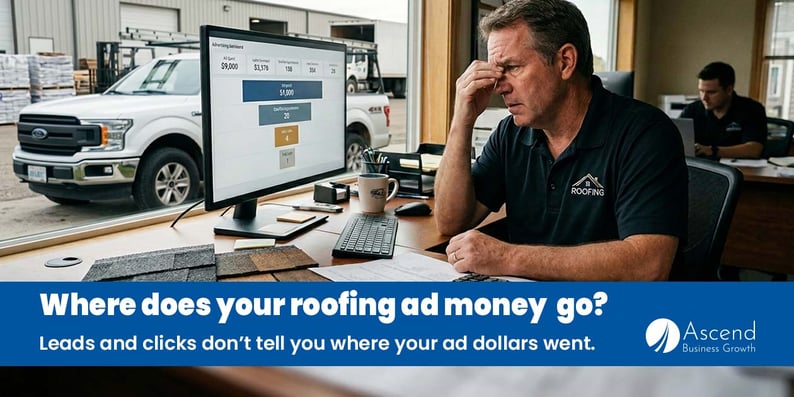
Leads are down. It's been a slow six weeks.
So the owner does the reasonable thing and calls the ad guy. Push the budget from $6,000 to $9,000. Get the phone ringing again.
And it works, sort of. More calls come in. A few more jobs close. The extra $3,000 produces something, so it stays.
What nobody checks is what happened to the calls that came in and went nowhere. The ones that hit voicemail on a Saturday. The ones where somebody promised to call back on Tuesday and didn't. The estimates that were delivered and never followed up on.
That's a revenue leak, and advertising is the one thing that makes every other leak in your business more expensive.
What's missing is the recognition that roofing ads don't create customers — they buy attempts. Whether an attempt becomes a job depends entirely on what happens after the phone rings, and nothing about a bigger budget improves that part.
Here's the size of it. At $9,000 a month you're spending $108,000 a year. If a quarter of the opportunities your ads generate die somewhere in your own process, about $27,000 of that went to making a phone ring that nobody answered well.
This article covers what your roofing ads are actually buying, the warm audience almost no roofing company pays to reach, how the different ad types really work, and how to check whether your spend is producing jobs or just activity.
Table of Contents
- Key takeaways
- What do roofing ads actually buy?
- Why more ad spend makes an existing leak worse
- The warm audience you're not paying to reach
- Local Services Ads, search ads, and social ads aren't the same purchase
- Where does your ad actually send people?
- Are you paying for emergencies or for research?
- Storm season and the always-on budget
- Can you tell which ads produced jobs?
- What does wasted roofing ad spend cost you?
- How to check your own roofing ads
- What does good roofing ad spend look like?
- How do roofing ads fit into the bigger revenue picture?
- Find your roofing revenue leaks
- Roofing ads FAQs
Key takeaways
- Roofing ads buy attempts, not customers. What happens after the phone rings decides whether the money worked.
- Every gap in your process gets multiplied by ad spend, which is why increasing the budget often produces less than expected.
- The cheapest audience you can reach is people who have already visited your site, used your estimator, or gotten a quote, and almost no roofing company advertises to them.
- Local Services Ads, search ads, and social ads have completely different economics and shouldn't be compared as one line item.
- You can check most of this yourself by clicking your own ads and following what happens.
What do roofing ads actually buy?
Roofing ads buy attention at the moment somebody is looking, and nothing beyond that.
That sounds obvious, and it changes how you should think about the spend. You're not buying jobs. You're buying the chance to have a conversation, and the price of that chance keeps going up.
Everything that happens after the click or the call is your business, not the ad platform's. Whether somebody picks up. Whether the website makes the next step obvious. Whether an estimator follows up on Thursday like he said he would.
This is why two roofing companies can spend identical amounts on identical ads in the same market and get very different results. The ads performed the same. The companies didn't.
It also explains something owners find frustrating: ad performance reports that look good while the business doesn't feel good. Impressions, clicks, and cost per lead all describe the part the platform controls. None of them describes whether you got the work.
Why more ad spend makes an existing leak worse
Advertising is a multiplier. Whatever your business currently does with an opportunity, ads make it do more of that — including the losing.
Walk the path a paid call actually takes. It rings a tracking number, which forwards somewhere, which reaches a person or doesn't. If it reaches someone, they take a message or set an appointment. An estimator goes out, delivers a number, and either follows up or doesn't.
Ad spend increases the traffic on that path. It doesn't repair any of it.
So if 25% of your opportunities die somewhere in that sequence, then 25% of every new advertising dollar buys nothing. Doubling the budget doubles the waste alongside the results.
Which produces a pattern I see constantly: an owner increases spend, gets a smaller lift than expected, concludes the ads are underperforming, and switches vendors. The new vendor produces roughly the same result, because the ads were never the problem.
The practical order of operations is unglamorous. Fix the cheapest gaps first — the ones that cost nothing, like a phone number that doesn't reach anyone after hours or an estimate backlog nobody works. Then turn up the spending into a process that converts.
Spending more on advertising is the most expensive way to grow. It should be the last lever, not the first.
The warm audience you're not paying to reach
Almost every dollar a roofing company spends on ads goes toward strangers, while the people who have already raised their hand get nothing.
Think about who your business has already touched this year:
- Homeowners who visited your website and didn't contact you
- People who used your online estimator and disappeared
- Everybody who got a quote and didn't buy
- Customers from three, five, ten years ago
- Neighbors of jobs you're currently building
Every one of those groups is warmer than a cold search click, and reaching them costs a fraction of what you're paying to find new people.
Retargeting — showing ads to people who have already interacted with you — is standard practice in most industries and nearly absent in roofing. Part of that is the sales cycle: a homeowner who priced a roof in March might buy in September, and most advertising is set up to chase this week.
But that gap is exactly the opportunity. A homeowner who got three quotes in spring and waited is going to buy from somebody eventually. Being the company they keep seeing costs very little.
The neighborhood version is even cheaper. While your crew is on a roof, the households around it are the highest-intent audience you'll ever have, and you can advertise to that specific area for the week you're working there. That's the same audience your finished-job photos should be reaching for free.
None of this replaces search advertising. It's the part of the budget that isn't competing against every other roofer in the county for the same click.
Local Services Ads, search ads, and social ads aren't the same purchase
These three get lumped together as "advertising" on a P&L, and they behave nothing alike.
Local Services Ads appear at the very top of search results, charge you per lead rather than per click, and require Google to verify your licensing and insurance. The economics are the cleanest of the three — you're paying for a contact, not a visit — and you can dispute leads that clearly aren't yours. The catch is that you're competing on responsiveness and reviews, and being slow to answer affects how often you're shown.
Search ads charge per click and put you in front of somebody actively looking. Highest intent, highest cost, and completely dependent on where you send people and who answers.
Social ads reach people who weren't looking for a roofer at all. That makes them poor for emergencies and good for two specific things: the neighborhood around an active job, and staying in front of homeowners who already talked to you.
The mistake is comparing them on cost per lead as though the leads are equivalent. A Local Services Ad lead is a phone call from someone with a problem right now. A social lead is somebody who filled out a form while scrolling. Both can be worth having. They close at very different rates, and averaging them together tells you nothing useful.
Where does your ad actually send people?
A homeowner who clicks an ad about emergency roof repair should land on a page about emergency roof repair. A surprising number land on a homepage instead.
That's a paid click arriving at a page that asks them to figure out where to go next. Some will. Many won't, and you paid the same either way.
Worth checking on your own ads:
- Does the page match what the ad promised, or is it a general homepage?
- On a phone, can you see a way to contact them without scrolling?
- Is the phone number tap-to-call?
- If the ad mentioned a specific town, does the page mention it?
- Does the page tell them what happens after they reach out?
The mismatch between ad and landing page is one of the more common and more fixable problems in roofing advertising, and it costs nothing to correct. It's also the point where paid traffic runs into every problem your website already has, except now you're paying for each visitor.
Are you paying for emergencies or for research?
"Roof repair near me" and "how much does a new roof cost" are two completely different customers, and they shouldn't get the same ad, the same page or the same budget.
The first person has a problem right now and will call whoever answers. That click is expensive and worth it.
The second is researching, possibly months out, possibly just curious about their neighbor's project. That click is cheaper and converts much later, if at all.
Both are legitimate. The trouble comes when they're mixed into one campaign with one budget and one landing page, because then your cost per lead is an average of two things that behave differently, and you can't tell which half is working.
The same applies geographically. If your campaign is set to a 40-mile radius but you only profitably work within 20, you're paying for clicks from homeowners you'd have to drive an hour to reach. That's a setting, and it's worth looking at.
Storm season and the always-on budget
Roofing demand is lumpy, and most roofing ad budgets are flat.
A hailstorm creates more qualified demand in three days than a month of ordinary advertising. A slow February creates almost none. Spending the same amount in both weeks is a choice most companies have never actually made — it's just what the budget was set at.
Two things are worth deciding in advance rather than in the moment.
What happens when a storm hits. Can you increase spend within a day, in a specific area? If that requires three phone calls and a week, you'll miss the window when homeowners are actively searching.
What happens when you're already full. Running full-price ads while your crews are booked six weeks out is buying leads you'll respond to slowly and frustrate. That's the one time reducing spend is the right answer, and almost nobody does it.
Ad platforms are happy to spend your money evenly. Your business doesn't work evenly.
Can you tell which ads produced jobs?
Most roofing companies can report leads by campaign, but cannot report jobs by campaign. Those are different questions, and only one of them justifies a budget.
The reports your ad platform produces stop at the lead, because that's where the platform's visibility ends. Everything after — the appointment, the estimate, the sale — happens in your business, and connecting the two is your job.
When that connection doesn't exist, you end up optimizing toward whichever campaign produces the most leads, which is not necessarily the one producing the most revenue.
That problem is big enough to have its own article, and I wrote about it in bad marketing attribution and what it costs your margin. For this article, it's enough to say that a cost-per-lead number without a cost-per-job number underneath it can't tell you whether to spend more.
What does wasted roofing ad spend cost you?
Twice over — the money you spent, and the job that went to whoever handled the same opportunity better.
These are illustrative numbers. Use your own.
Say you spend $9,000 a month on advertising and it produces 45 opportunities. If a quarter of those die inside your own process — unanswered calls, slow callbacks, estimates nobody followed up on — that's about 11 opportunities a month and roughly $2,250 of that month's spend buying nothing.
Over a year, that's $27,000 of your $108,000 budget spent making phones ring that nobody answered well.
Then there's the other side. Those 11 missed opportunities aren't 11 lost jobs. At a 25% close rate and a $12,000 average job, they represent about $33,000 a month in potential sold revenue — roughly $396,000 over a year if the same pattern continued, and it went to a competitor who handled the same opportunity better.
None of that shows up in an advertising report. The report will say those leads were delivered, and it'll be right.
How to check your own roofing ads
You can find most of the problems in about 10 minutes by becoming your own customer.
Test 1: Click your own ad on a phone
Search a phrase you're bidding on, from a phone that isn't signed into anything of yours, and click your own ad.
- Where did it take you? Does that page match the ad?
- Without scrolling, can you see how to contact the company?
- Is the phone number tap-to-call?
- Does anything tell you what happens after you reach out?
Yes, this costs you the price of a click. It's the cheapest audit you'll ever run.
Test 2: Call the number in the ad
Do it on a Tuesday afternoon and again on a Saturday morning. Note how many rings, who answered and what they said.
Every ad dollar you spend flows through that phone path.
Test 3: Check your geography settings
Open your campaign settings and look at the target area. Compare it to where you actually make money.
If the radius is bigger than your profitable service area, you're paying for clicks you can't serve well.
Test 4: Find your retargeting
Ask whoever runs your ads what you're currently spending to reach people who have already visited your site, used your estimator, or received a quote.
If the answer is nothing, that's the finding. It's usually the cheapest audience available, and it's usually untouched.
Test 5: Try to connect one campaign to one job
Pick a job you sold last month. Can you trace it back to a specific campaign?
Then pick a campaign. Can you say how many jobs and how much revenue it produced?
If either direction is a dead end, your advertising decisions are being made on lead counts.
Found an advertising gap?
The free Roofing Revenue Leak Check looks for the other places where leads and opportunities may be slipping through your business.
Check your roofing revenue leaks →
What does good roofing ad spend look like?
The money goes to a process that converts, and you can tell which part of it produced work.
The free gaps get fixed first. Phone routing, response time, follow-up. Advertising into a leaky process is the most expensive possible way to buy growth.
Each ad type is judged on its own terms. Local Services Ads, search, and social produce different leads at different costs that close at different rates. Averaging them hides everything useful.
Ads land where they promised. A specific ad goes to a specific page that mentions the specific thing, and contacting you is possible without scrolling.
Some budget goes to people who already know you. Past visitors, old quotes, previous customers, and the neighborhoods where your crews are working this week.
Spend moves with demand. Up when a storm hits, down when you're booked out six weeks, rather than the same number every month, because that's what it's always been.
Source information survives to the sold job. Otherwise, you're deciding next year's budget from lead counts, which measures the platform's product rather than your business.
How do roofing ads fit into the bigger revenue picture?
Advertising sits at the very first stage, and it multiplies everything that happens after it.
Lead source → Lead capture → Response → Qualification → Appointment → Estimate → Follow-up → Sale → Measurement
Every other leak in this series happens at one or two stages. This one touches all of them, because ad spend is the volume knob on the whole process. It doesn't change the shape of what you've built. It just pushes more through it.
That's why the order matters so much. A company that fixes its phone path, its response, and its follow-up and then increases spend gets a larger return on every dollar. A company that increases spend first is paying retail to discover the gaps it already had.
It's also why advertising is usually the wrong first answer to a slow month. It's the fastest lever and the most expensive one, and it works best last. The free version of the same visibility is your search presence, and most roofing companies have never finished setting that up.
This is one of fifteen revenue leaks that waste good roofing leads, and it's the one that makes all the others cost more.
Find your roofing revenue leaks
You may not need a bigger ad budget. You may need to find out what's happening to the opportunities the current one is already producing.
The free Roofing Revenue Leak Check looks across your lead-to-revenue process to find where opportunities may be slipping through — from how homeowners find and contact you through response, appointments, estimates, follow-up, sales, and measurement.
We start with one short call. Then I look at what's public and, where it helps, what's happening inside your process. You get a plain-English list of what may be leaking, roughly what it may be costing you, and what I'd fix first. If nothing's leaking, you'll know that for certain instead of guessing. No pitch buried inside it.
Check your roofing revenue leaks →
Roofing ads FAQs
Are Local Services Ads better than Google search ads for roofers?
They're a different purchase. Local Services Ads charge per lead rather than per click and require verification of your licensing and insurance, which makes the economics cleaner and puts you at the top of results. Search ads charge per click and depend heavily on where you send people. Most roofing companies benefit from both, judged separately rather than averaged into one cost per lead.
How much should a roofing company spend on ads?
Less than you'd think until the process behind the phone converts well, and more than you'd think once it does. A dollar spent advertising on unanswered calls and unworked estimates buys nothing. The useful sequence is to fix the free gaps first, then increase spend into something that turns opportunities into jobs.
Should roofing companies use retargeting ads?
Yes, and very few do. Homeowners who visited your site, used your estimator or received a quote and didn't buy are far warmer than a cold search click and cost much less to reach. Roofing has a long consideration window, so someone who priced a roof in spring may buy in fall, and staying visible to them is inexpensive.
Why aren't my roofing ads working?
Before changing vendors, check what happens after the click. Where the ad lands, whether the phone number reaches a person on a Saturday, how fast somebody follows up, and whether estimates get worked. Ads are a volume knob on your existing process, so a disappointing return on increased spend usually points at the process rather than the ads.
How do I know if my roofing ads are producing jobs?
Connect campaigns to sold jobs rather than to lead counts. Ad platforms report as far as the lead because that's where their visibility ends. If you can't take a job you sold last month and trace it back to a campaign, or take a campaign and say what revenue it produced, you're making budget decisions on the platform's measure of its own product.


Comments