
Roofing owners tell me they want to "show up." Most have no way to check whether they do. Here's what roofing SEO actually means and how to test yours.
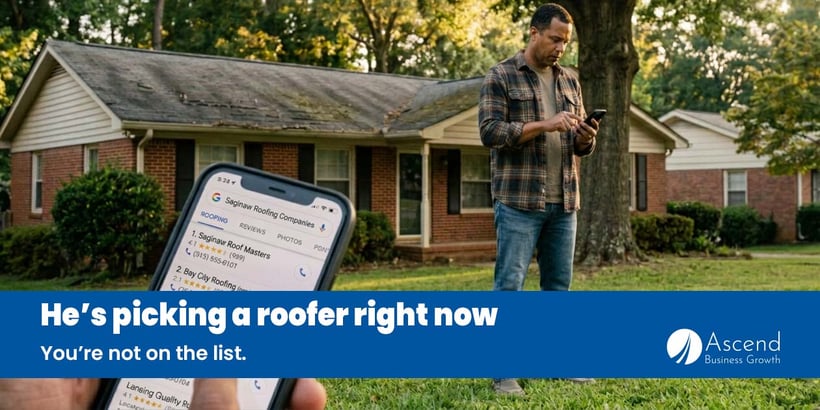
I get this call a few times a year. A roofing owner says some version of: we need to show up better.
When I ask what that means, the answer is usually a shrug. Show up on Google. Be at the top. Not be buried.
And when I ask whether they currently show up, the answer is almost always the same: yeah, we're fine, I just Googled us.
That last sentence is the problem. He searched from his own office, on his own phone, for his own company name, while signed into his own Google account. Of course he came up first. Google knows exactly where he's standing and exactly who he is.
The homeowner two towns over, searching "roof repair near me" at 8 pm during a storm, is seeing something completely different. And nobody at the company has ever looked at it.
That's a revenue leak, and it's the one that costs you homeowners who were ready to call somebody and never saw your name.
What's missing is roofing SEO — making sure your company shows up when someone nearby searches for the work you do, across every place those searches are answered now.
This article covers what "showing up" actually means in 2026, why you can't check it from your own phone, what it costs to be invisible in half your service area, and how to see what a homeowner really sees.
Table of Contents
- Key takeaways
- What is roofing SEO, and where does local fit in?
- What does "showing up" actually mean now?
- Why you can't check your own rankings from your own phone
- Why you rank in your town and nowhere else
- What your Google Business Profile is actually doing
- What happens when a homeowner asks an AI assistant instead
- The old listings you forgot about
- What does weak roofing SEO cost you?
- How to see what a homeowner actually sees
- What does good roofing SEO look like?
- How does roofing SEO fit into the bigger revenue picture?
- Find your roofing revenue leaks
- Roofing SEO FAQs
Key takeaways
- Searching for your own company from your own office tells you nothing. Google personalizes results by location and by who you are.
- Local rankings change from one part of town to another. You can dominate your own zip code and be invisible fifteen minutes away.
- "Showing up" now means several different things: the map results, AI-generated answers, ads, and what AI assistants say when someone asks them directly.
- Your Google Business Profile does more work than your website for urgent searches, and most roofing companies have never fully filled one out.
- You can see what a homeowner actually sees in about 10 minutes, for free, from a phone.
What is roofing SEO, and where does local fit in?
Roofing SEO is everything that affects whether your company shows up in search results, and the local part is what actually produces phone calls.
There's a difference worth understanding. Ranking a page for a topic — an article about hail damage, say — is ordinary SEO, and it brings you readers. Being one of the handful of companies shown to a homeowner searching from three miles away is local SEO, and it brings you jobs.
Most roofing owners asking about SEO are really asking about the second one. That's where the emergency calls come from.
The distinction matters because of how those results get built. A homeowner searching "roof repair near me" isn't getting a list of the ten best roofing articles. They're getting a very short list of companies, chosen largely on proximity, and your website is only one input into that decision.
Which means a roofing company can have a genuinely good website and still be invisible for the searches that produce emergency calls. The reverse is true too: getting found doesn't help if the site doesn't give a homeowner a reason to call.
What does "showing up" actually mean now?
It means at least four different things, and they're each decided differently. This is the part that trips roofing owners up, because they're thinking about one thing and their customers are experiencing another.
When a homeowner searches for a roofer, they might get:
- Local Services Ads at the very top, which you pay per lead and which require Google's screening and licensing checks.
- An AI-generated answer summarizing a few local options, sometimes naming only one or two businesses.
- The map results, the box with the map and business listings, which has historically shown three companies.
- Ordinary search results, further down, where your actual website lives.
Those are four separate competitions. You can win one and lose the rest. Two of them you pay for by the click or by the lead, and spending more there doesn't help if the process behind the phone isn't ready.
The mix has also shifted recently. Industry tracking through 2025 and 2026 shows AI-generated answers appearing on a growing share of local searches, sometimes replacing the traditional map results — and when they do appear, they tend to name fewer businesses than the map box did.
The practical translation for a roofing owner: the number of companies a homeowner sees before they choose one is getting smaller. Being fourth was always bad. It's getting worse.
Why you can't check your own rankings from your own phone
Google personalizes what it shows you based on where you are and what it knows about you, which makes your own search results the least reliable test available.
Three things are working against you when you check:
You're standing in your own building. Proximity is one of the strongest factors in local results. Searching from your office is the single most favorable location you could pick.
Google knows it's you. You're signed in. You've visited your own website hundreds of times. You've clicked your own listing. That history shapes what you see.
You searched your company name. Of course you came up. Nobody else is competing for your company name. That result tells you your listing exists, and nothing else.
So "I just Googled us, and we're fine" is like testing whether your truck starts by asking the guy already sitting in it with the engine running.
The test that matters is the one a stranger runs: not your name, from a different part of town, on a phone that's never heard of you.
Why you rank in your town and nowhere else
Local search results change block by block, and a roofing company serving five towns is really competing in five separate markets.
This surprises owners more than anything else in roofing SEO. You can be the top result in your own town and completely absent in the next one over, in the same week, for the same search.
That's because Google is answering a question about nearness, and nearness changes depending on who's asking. A homeowner fifteen miles away gets results built around where they are, not where you are.
For a roofing company, that matters a lot, because your service area is probably much larger than your physical footprint. You'll happily drive forty minutes for a replacement. Google doesn't know that unless you've told it, and even then, proximity carries weight.
The practical consequence: if most of your work comes from three towns and you've only ever checked how you rank in one of them, you don't know how you're doing. You know how you're doing at your desk.
What your Google Business Profile is actually doing
For urgent roofing searches, your Google Business Profile does more work than your website. A homeowner with water coming in often calls straight from the listing without ever visiting your site.
That's why it's strange how many roofing companies have a profile set up once years ago and never touched again.
The parts that matter, and that most companies have left half-finished:
- Categories. Your primary category carries real weight. "Roofing contractor" is different from "construction company," and the wrong choice quietly limits what you appear for.
- Service areas. If you serve five towns, they should be listed. Most profiles list one.
- Services. Repair, replacement, storm damage, inspection, gutters. Each one is a thing people search for.
- Hours, including whether you handle emergencies. A profile that says you close at 5 pm tells a Saturday caller not to bother.
- Photos. Real jobs, real crews, recent. Not the stock photo from the website built in 2019.
- Reviews and responses to them. This is the biggest single differentiator in most local markets, and it's the one thing your competitor can't buy quickly.
- Questions and answers. Anyone can post a question on your listing. Anyone can also answer it. Most owners have never looked.
None of that costs money. It costs an afternoon, and then fifteen minutes a month. The photos are the easiest part, because they come from jobs you're already finishing — the same sixty seconds that feeds everything you'd post anywhere else.
What happens when a homeowner asks an AI assistant instead
A growing number of homeowners now ask an AI assistant for a recommendation rather than running a search at all. "Who's a good roofer in my area" is a question people type into ChatGPT and similar tools the same way they'd ask a neighbor.
That's a different competition again, and it's one nobody in roofing is actively managing yet.
What those tools draw on is roughly the same raw material Google uses — your listing, your reviews, your website, mentions of your business elsewhere — but they weigh consistency heavily. When an AI assistant recommends a business, it makes a claim, and it prefers businesses with unambiguous information.
The practical implication is old-fashioned: your name, address, phone number, hours and service area should say the same thing everywhere they appear. A company with three different phone numbers floating around the internet is harder for any system to confidently recommend.
That's not a new tactic. It's the same hygiene roofing SEO always asked for, now with higher stakes.
The old listings you forgot about
Most roofing companies have listings scattered across the internet that nobody has looked at in years, and some of them are wrong.
Directory sites, old contractor marketplaces, the chamber of commerce, a supplier's "find a contractor" page, an aggregator that scraped your information in 2018. Some you created. Some you didn't.
Each one is a small vote for who your business is. When they disagree — old address, disconnected number, a name you stopped using — that confusion works against you in every system that's trying to decide whether to show you.
And there's a more direct cost. A homeowner who finds an old listing with a number that no longer reaches you doesn't conclude the listing is out of date. They conclude you didn't answer. That's the same failure I wrote about in call routing problems that lose roofing jobs, arriving from a direction most owners never think to check.
What does weak roofing SEO cost you?
It costs you the homeowners with the highest intent and the shortest patience — the ones searching right now, ready to call somebody today.
These are illustrative numbers. Use your own.
Say you serve four towns and you're visible in two of them. In the other two, a homeowner searching for a roofer sees three or four companies, and you aren't one of them.
If each of those towns would produce five inbound calls a month, that's ten calls you never get. At a 25% close rate and a $12,000 average job, roughly $30,000 a month in work you were never considered for.
The thing that makes this leak different from the others is that there's no evidence of it anywhere in your business. No missed call, no unreturned form, no lost estimate. The homeowner had a problem, searched, found somebody, and got their roof fixed. You never existed in that story.
It's also the cheapest one to fix. Most of what's wrong with a roofing company's search presence is unfinished rather than broken, and finishing it is free.
How to see what a homeowner actually sees
You can do this in about 10 minutes from a phone, and the first test is the one that usually surprises people.
Test 1: Search like a stranger, from somewhere else
Next time you're in another town you serve — picking up material, driving to a job — pull out your phone, open a private or incognito browser window, and search "roof repair near me."
Don't search your company name. Search the way somebody with a problem would.
Write down what you see, in order. Are you in it at all? How far down?
Test 2: Do it in every town you serve
Repeat in each town that produces real work for you. This takes a few weeks of opportunistic checking, or ten minutes if you ask someone who lives there to do it and send you a screenshot.
The pattern is the finding. Most roofing companies discover they're strong in one or two places and invisible in the rest.
Test 3: Pull up your own Google Business Profile as a customer
Not the management dashboard — the listing as a homeowner sees it.
- Is the primary category right?
- Are all your service areas listed?
- Are the hours accurate, including what happens after hours?
- When was the most recent photo added?
- When was the most recent review, and did anyone respond to it?
- Has anyone asked a question that nobody answered?
Test 4: Ask an AI assistant for a roofer in your area
Open ChatGPT or a similar tool and ask for a good roofing company in one of your towns. See what comes back, and whether anything it says about you is wrong.
This takes ninety seconds and almost no roofing owner has ever done it.
Test 5: Search your phone number
Put your main number in quotes into Google and see where it appears. Then do the same with any old number you've used.
Old listings, wrong numbers and dead directory pages will surface here. Every one that still lists a number you don't answer is a homeowner who will conclude you ignored them.
Found a visibility gap?
The free Roofing Revenue Leak Check looks for the other places where leads and opportunities may be slipping through your business.
Check your roofing revenue leaks →
What does good roofing SEO look like?
A homeowner in any town you serve can find you, and everything they find agrees with itself. That's the bar, and most of it is free.
A complete Google Business Profile. Right category, every service area, every service, accurate hours, recent photos, and somebody responding to reviews.
The same information everywhere. One business name, one address, one main phone number, consistent across your website, your listings and anywhere else you appear.
A page for each town that matters. If you do real volume in four towns, a page about your work in each — actual jobs, actual neighborhoods, not the same paragraph with the name swapped.
A steady flow of reviews. Not a burst once a year. Reviews are both a ranking factor and the thing a homeowner reads before calling, and the only reliable way to get them is asking every customer at the moment the job finishes.
Somebody checks quarterly. Fifteen minutes, from a phone, in a town you serve. That's the whole maintenance plan.
Notice what isn't here. No agency retainer required to get this far. Most roofing companies I look at have never completed the free part, which makes paying for the advanced version a strange first move.
How does roofing SEO fit into the bigger revenue picture?
This is the leak that happens before anything else in your process exists.
Lead source → Lead capture → Response → Qualification → Appointment → Estimate → Follow-up → Sale → Measurement
Roofing SEO sits at the very first stage, which makes it different in kind from the leaks after it. Everywhere else in this process, you lose something you had. Here, you never had it. The homeowner searched, chose from what they were shown, and your company wasn't in the set.
That's why it's invisible from inside the business. There's no record of a search you didn't appear in. Nothing to review, nothing to notice, no number that goes down.
It also quietly distorts everything downstream. If you're only visible in two of four towns, your lead volume looks like a market problem rather than a visibility problem, and the natural response is to buy more ads — paying for reach you could have had for free.
This is one of fifteen revenue leaks that waste good roofing leads, and it's the only one where the homeowner never knew you existed.
Find your roofing revenue leaks
You may not need more leads. You may need to find out why homeowners in half your service area have never heard of you.
The free Roofing Revenue Leak Check looks across your lead-to-revenue process to find where opportunities may be slipping through — from how homeowners find and contact you through response, appointments, estimates, follow-up, sales and measurement.
We start with one short call. Then I look at what's public and, where it helps, what's happening inside your process. You get a plain-English list of what may be leaking, roughly what it may be costing you, and what I'd fix first. If nothing's leaking, you'll know that for certain instead of guessing. No pitch buried inside it.
Check your roofing revenue leaks →
Roofing SEO FAQs
What is roofing SEO?
Roofing SEO is everything that affects whether your company turns up when somebody searches for the work you do. It splits into two parts: ranking pages for topics, which brings you readers, and local visibility, which brings you jobs. For most roofing companies, the local half is what produces phone calls, and it depends on your Google Business Profile, your reviews, and the consistency of your business information across the internet.
How do I check where my roofing company ranks?
Not by searching from your own office on your own phone, which is the most favorable possible test. Use a private browsing window, search a service phrase rather than your company name, and do it from different towns you serve. Local results change by location, so one check tells you about one spot.
How important is a Google Business Profile for a roofing company?
For urgent searches, it often matters more than your website, because homeowners frequently call straight from the listing without visiting your site. Category, service areas, hours, photos and reviews all feed both what Google shows and what a homeowner decides. Completing it costs nothing.
Why does my roofing company rank in one town but not another?
Because local results are built around where the searcher is standing, not where your business is. A roofing company serving five towns is competing in five separate markets, and proximity carries real weight in each. Listing your service areas and building genuine content about the places you work helps, but you should expect to be strongest closest to home.
How do I get recommended when someone asks AI for a roofer?
AI assistants draw on the same underlying information as search — your listing, reviews, website and mentions elsewhere — and they favor businesses whose details are consistent and unambiguous. The most useful thing you can do is make sure your name, phone number, service area and hours say the same thing everywhere they appear, then ask an assistant about your own company and see what it gets wrong.


Comments