
Most roofing companies have two kinds of leads: an estimate scheduled or nothing. Here's what that costs and what belongs in between.
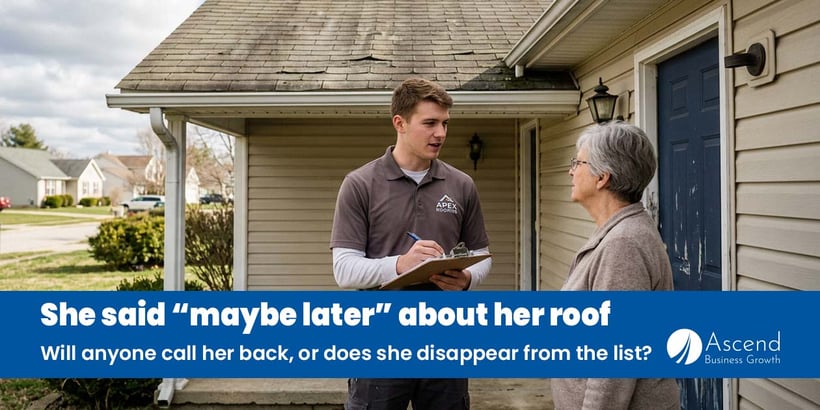
A crew knocks a neighborhood on a Saturday after a hailstorm. Thirty conversations by the end of the day.
Four homeowners say yes to an inspection. Those get scheduled, because an appointment forces somebody to write it down.
Nine say some version of not right now. After bonus season. Once we hear back from the insurance company. Next spring, probably. Check back with me.
The other seventeen aren't interested.
Monday morning, the four are on the calendar. The seventeen are correctly forgotten. And the nine — the ones with a damaged roof, a real intention, and a date attached — are a note on a clipboard in somebody's truck.
By Wednesday they're gone.
That's a revenue leak, and it happens because most roofing companies have exactly two places to put a lead: an estimate on the calendar, or nothing at all.
What's missing is lead qualification — knowing enough about each person to decide what happens next and when, instead of sorting everyone into ready today or forgotten.
Here's the size of it. Nine conversations a Saturday, even at a handful of storm weekends a year, is dozens of homeowners who told you they'd buy eventually. At a $12,000 average job, recovering three of them a year is $36,000 from work you've already done.
This article covers why inbound roofing leads barely need qualifying, why outbound leads need something different, what the missing bucket costs you, and how to check what your own company does with a "maybe."
Table of Contents
- Key takeaways
- Why roofing lead qualification isn't like other industries
- Where outbound roofing leads come from
- What happens to a homeowner who says "not right now"?
- What your pay structure tells canvassers to ignore
- What does poor lead qualification cost a roofing company?
- How to check your own lead qualification
- What does good roofing lead qualification look like?
- How does lead qualification fit into the bigger revenue picture?
- Find your roofing revenue leaks
- Roofing lead qualification FAQs
Key takeaways
- Roofing doesn't need the qualification process other industries use. Anyone who calls a roofer already wants an estimate.
- Inbound leads need triage, not qualification: how urgent, what kind of work, is it in your area, is insurance involved.
- Outbound leads are different. Door knocking and neighborhood canvassing produce a large group of homeowners who will buy, just not today.
- Most roofing companies have two states for a lead: estimate scheduled, or nothing. Everything not ready today falls into nothing.
- You can check this in about 10 minutes by asking one canvasser what happened to the maybes from a specific Saturday.
Why roofing lead qualification isn't like other industries
In most industries, qualification separates people who might buy from people who are just looking. In roofing, almost everyone who contacts you is already buying.
Nobody calls a roofing company to browse. There's no education phase where you convince a homeowner that a leaking roof is a problem worth solving. They already know. That's why they called.
Inbound roofing leads need triage, not qualification. The question isn't whether this person is worth talking to. It's what kind of conversation they need and how fast.
Four things decide that, and none of them are about the homeowner's budget:
- How urgent is it? Active water coming in is a different response than planning for next spring.
- Repair or replacement? Different people handle these at different companies, and they can cost wildly different amounts.
- Is it in your service area? The most common wasted truck roll in roofing is a good lead 45 minutes outside the zone.
- Is insurance involved? An insurance job has a different timeline, a different conversation and often a different person who should handle it.
Those four answers can come from two or three questions on your form and one on the phone. That's the whole thing. The first answer in particular decides how fast somebody needs to call back, which is the difference between winning an emergency job and hearing about it later.
But that's only half your lead flow, and the other half works completely differently.
Where outbound roofing leads come from
Outbound is every roofing lead that starts with you reaching out, not a homeowner contacting you. And it behaves nothing like inbound.
In roofing, that usually means:
- Door knocking a neighborhood after a storm
- Driving around and noting roofs that clearly need work
- Following up with the neighbors of a job you're currently building
- Mailing a list in a target area
- Reaching back out to homeowners you quoted a year or two ago
The difference is timing. An inbound lead contacted you because something happened to them this week. An outbound lead was living their life until somebody knocked, and their roof has been mediocre for three years without becoming urgent.
So the answer you get from outbound isn't usually yes or no. It's later. And later is the single most common outcome of every outbound effort a roofing company makes.
What happens to a homeowner who says "not right now"?
In most roofing companies, nothing happens, because there's nowhere for them to go.
Listen to what a homeowner is really telling you when they say "not right now." Usually it's specific:
- "After the first of the year, when I get my bonus."
- "We're waiting to hear back from the insurance company."
- "My husband wants to get through the wedding first."
- "Next spring, once we see if it makes it through winter."
- "I've got someone else coming out Thursday."
Every one of those contains a date or an event. They aren't rejections. They're appointments the homeowner made with themselves.
And they're better than cold leads by a wide margin. This person has a roof with a known problem, has already met somebody from your company, and has stated an intention out loud. Compare that to a name on a mailing list.
The trouble is that a maybe doesn't force a record the way an appointment does. Nobody has to enter it into anything. So it gets written on a clipboard, or typed into a notes app, or just remembered — and remembered lasts about four days.
What your pay structure tells canvassers to ignore
If your canvassers are paid on closed work, you've told them the maybes are worthless. Not in words, but clearly.
Think about the incentive from inside the truck. A knocker gets paid when a job closes. Of thirty conversations, four turn into inspections that might close this month. Nine turn into maybes that might close in eight months, if somebody remembers, which nobody will.
The rational move is to spend all your energy on the four and let the nine go. That's not a character problem. That's the comp plan doing exactly what it was designed to do.
That means recording the maybes has to be somebody's job, with something attached to it—a small payment per recorded conversation, credit when one converts later, or simply the company owning that step instead of the canvasser.
The version that never works is asking people to do unpaid administrative work at the end of a ten-hour Saturday because it's good for the business.
What does poor lead qualification cost a roofing company?
Every maybe you don't record is a conversation you paid for twice — once when you had it, and again when you have to find that homeowner from scratch next year.
These are illustrative numbers. Use your own.
Say you canvass ten Saturdays a year and average nine maybes a day. That's 90 homeowners annually who told somebody from your company they intend to do something about their roof.
If you recovered even 10% of them, that's nine jobs. At $12,000 average, $108,000 in revenue from conversations you already had and already paid for.
You won't get all of them. Some will forget you, some will use the roofer their brother-in-law recommends, some will patch it and wait another five years. But right now you're getting close to zero, because nobody can call a list that doesn't exist.
There's a second cost that's harder to see. Without a record, you also can't tell whether canvassing works. You know how many jobs closed the same week, which understates it badly, and you have no idea how many closed six months later because nobody connected that job back to a Saturday in May.
How to check your own lead qualification
You can find this leak in about 10 minutes, and the first test is the whole thing.
Test 1: Ask about one specific Saturday
Pick a canvassing day from three or four weeks ago. Ask whoever was out there: how many conversations, how many inspections, and how many people said maybe?
Then ask where those maybes are.
Don't accept "in my phone" as an answer without looking. Ask to see it. What you find — a notes app, a photo of a clipboard, nothing — is the finding.
Test 2: Try to produce the list
Right now, without calling anybody, try to write down every homeowner who has told your company in the last six months that they'd be ready later.
If you can't, that's the leak. Not a moral failing, just the answer.
Test 3: Check whether anything has a date
For any maybes you can find, look for a date. Not "check back later" — an actual day when somebody is supposed to call.
A list with no dates on it is an archive, not a pipeline. Nobody will ever work it, because there's no moment when it becomes today's problem.
Test 4: Ask your office what happens to an inbound repair call
Call your own office as a homeowner with a small repair 40 minutes outside your normal area. See what happens.
- Does anyone ask where the house is before scheduling?
- Does anyone ask whether it's a repair or a replacement?
- Would an estimator have driven out there?
This is the inbound half, and it's usually cheap to fix.
Test 5: Look for last year's quotes
Find homeowners you estimated twelve to eighteen months ago who didn't buy. Can you produce that list?
Those people are outbound leads now, and they're better than any list you could purchase. Most roofing companies have never once called them.
Found leads that have nowhere to go?
The free Roofing Revenue Leak Check looks for the other places where leads and opportunities may be slipping through your business.
Check your roofing revenue leaks →
What does good roofing lead qualification look like?
Every homeowner who talks to your company ends up somewhere on purpose, with a date attached if they're not ready yet.
Inbound gets sorted in the first two minutes. Urgency, repair or replacement, service area, insurance. Two or three questions, not an interrogation.
Outbound has three outcomes, not two. Yes, no, and later. Later is a real bucket with real records in it, not a synonym for no.
Every later has a date and a reason. "March, after bonus season" is workable. "Sometime" isn't. The reason matters too — it's what your next conversation opens with.
Somebody's job includes recording them. With time allowed for it, or money attached to it, or both. Asking for unpaid data entry after a long Saturday doesn't work and never has.
Somebody works the list. A list nobody calls is just a more organized version of forgetting.
Notice what isn't required. No new software, no complicated stages, no sales methodology. Most roofing companies already have a place this could live. What they don't have is a decision that it should.
How does lead qualification fit into the bigger revenue picture?
Qualification is where a conversation becomes an opportunity, or stops being anything at all.
Lead source → Lead capture → Response → Qualification → Appointment → Estimate → Follow-up → Sale → Measurement
Everything before this stage is about getting in front of a homeowner. Everything after it assumes there's a record to work with.
This is the stage where that record either gets created or doesn't. A homeowner who says maybe and never gets written down doesn't move to the next stage — they fall out of the process entirely, and nothing downstream can recover them because nothing downstream knows they exist.
The same thing happens one stage later to estimates that get delivered and never followed up, which is the same leak with a bigger number attached.
It's also the stage that decides whether your marketing measurement means anything. If canvassing produces nine future jobs and you only ever count the four that closed that week, canvassing will look like a worse investment than it is, and you'll cut it.
This is one of fifteen revenue leaks that waste good roofing leads, and it's the one where the homeowner told you yes and nobody wrote it down.
Find your roofing revenue leaks
You may not need more leads. You may need to find out what's happening to the homeowners who already told somebody at your company that they're interested.
The free Roofing Revenue Leak Check looks across your lead-to-revenue process to find where opportunities may be slipping through — from how homeowners find and contact you through response, appointments, estimates, follow-up, sales and measurement.
We start with one short call. Then I look at what's public and, where it helps, what's happening inside your process. You get a plain-English list of what may be leaking, roughly what it may be costing you, and what I'd fix first. If nothing's leaking, you'll know that for certain instead of guessing. No pitch buried inside it.
Check your roofing revenue leaks →
Roofing lead qualification FAQs
How do you qualify roofing leads?
For inbound calls and form fills, qualification is really triage: how urgent the problem is, whether it's a repair or a replacement, whether the house is in your service area, and whether insurance is involved. Those four answers decide who responds and how fast. Anyone who contacts a roofing company already wants an estimate, so there's no need to establish interest.
How do you keep track of door knocking leads?
Give canvassers one fast way to record a conversation that isn't an appointment, simple enough to do on a porch. Capture who the homeowner is, what they said in their own words, and when somebody should follow up. The homeowners who say "not right now" are usually the most valuable output of a canvassing day and the most likely to disappear by Monday.
What should you do with a homeowner who says "not right now"?
Write down the reason and the date. Most versions of not right now contain both — after bonus season, once the insurance company responds, next spring. Turn that into a specific day when somebody will call, because a follow-up without a date on the calendar doesn't happen.
Should roofing companies follow up on old estimates?
Homeowners you quoted a year or two ago who didn't buy are better prospects than any list you could purchase. They have a roof with a known problem, they've met someone from your company, and a lot of them simply waited. Most roofing companies have never called them once.
How should you pay canvassers for leads that close later?
If canvassers are paid only on work that closes quickly, the incentive tells them to discard anyone who isn't ready now. Attaching something to recorded conversations — a small payment, later credit when one converts, or company-owned data entry — is what makes capturing those homeowners realistic rather than a favor you're asking for.


Comments