Revenue Leak Check for Growth-Stage B2B Companies
Every sales pipeline has a weak point. Let's find yours.
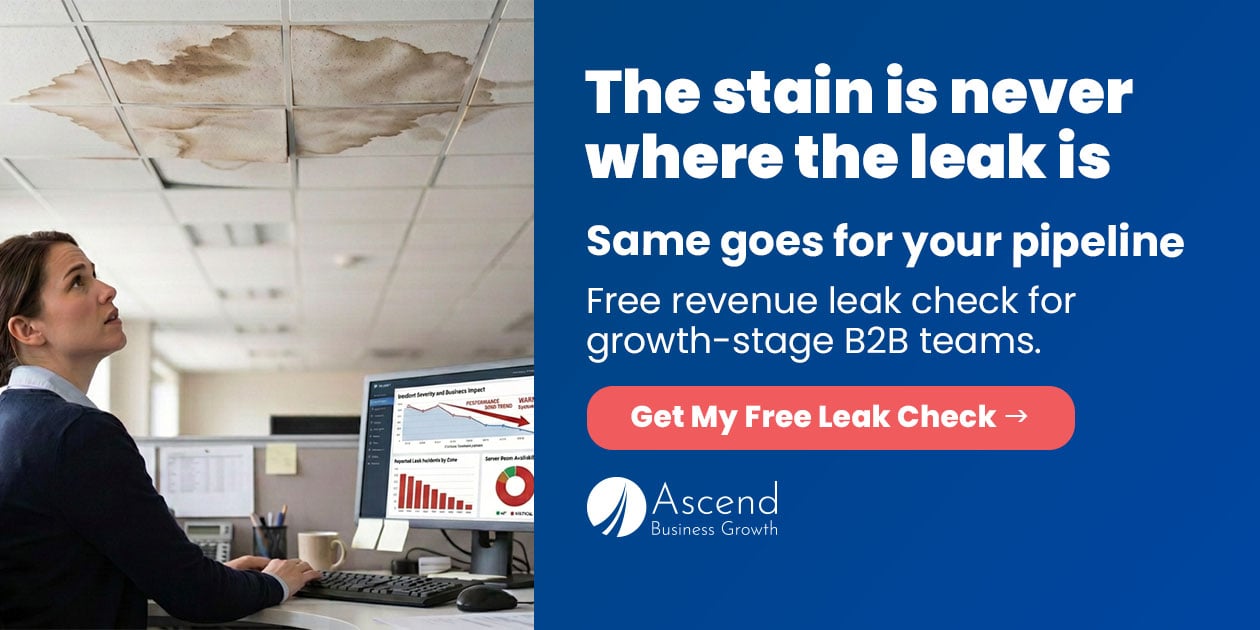
You may not need more leads. You may need to find out what's happening to the ones you already have.
The free Revenue Leak Check follows revenue through your business — from how buyers find you and raise their hand through routing, pipeline, handoff to delivery, renewal, and reporting. We look for the places where leads, deals, time, and margin can quietly slip away.
You get a clear picture of what's working, what's leaking, what it may be costing you and what we'd address first.
Here's a real revenue leak: One company's paid ad phone number just... rang. And rang. Their free listing worked fine. But calls coming through an ad they were paying for weren't reliably reaching anyone — and their team had already heard from callers who experienced it.
The company paid to generate the opportunity. The buyer did exactly what the company wanted them to do. The process broke in between.
That's a revenue leak. And phone routing is only one place it can happen.
What's in the Revenue Leak Check?
- What Is a Revenue Leak?
- We Follow Revenue Through Your Business
- How the Revenue Leak Check Works
- What You Get
- Why Is It Free?
- Think You Might Have a Revenue Leak?
- Frequently Asked Questions
What Is a Revenue Leak?
A revenue leak happens when your company creates an opportunity to make money, but something in the process keeps all or part of that revenue from reaching the bottom line.
Sometimes it's obvious. An inbound demo request sits unassigned for two days. A deal with no next step stays in the forecast for a quarter. A new customer's kickoff waits on information sales already had.
Other leaks are harder to see. Nobody can say which channel actually produces closed revenue. Pipeline stages mean something different to every rep. Renewals get noticed thirty days out instead of ninety. Marketing gets judged on MQLs because nobody can connect it to bookings.
Individually, these can look like small operational problems. Across hundreds of leads, deals, and customers, they get expensive.
The Revenue Leak Check is designed to find them.
We Follow Revenue Through Your Business
This isn't just a marketing audit, sales audit, or CRM audit. We follow the path a buyer and a deal take through your company and check where revenue can fall out along the way.
-
Getting Found: Can the buyers you actually want find you, and does what they find give them a reason to reach out? We look at search visibility, paid channels, LinkedIn presence, your website, and your conversion paths.
-
Getting the Conversation: When someone fills out a form, books a meeting, or replies to outreach, does that opportunity reliably reach the right person fast? We look at lead routing, speed-to-lead, qualification, and ownership.
-
Winning the Deal: Once there's a real opportunity, does your sales process consistently move it forward, or are good deals quietly going cold? We look at pipeline stages, next steps, deal hygiene, and forecast accuracy.
-
Keeping the Customer: A closed deal isn't the finish line. Does what sales promised actually reach the people delivering it? We look at the sales-to-onboarding handoff, implementation timelines, and early-customer experience.
-
Growing the Account: What happens after the customer is live? We look at renewals, expansion, referrals, and whether your customer base is consistently creating the next opportunity.
-
Seeing What's Working: Can leadership tell where revenue came from and spot a problem before it hits the forecast? We look at attribution, reporting, the numbers your systems can actually produce, and who's responsible for watching them.
How the Revenue Leak Check Works
1. We start with a short conversation
We spend 30 to 45 minutes learning how your business works: where pipeline comes from, who owns it at each stage, how deals move to delivery, what systems you use, and where you already suspect something isn't working.
We're not trying to learn everything about your company. We're building enough of the map to know where to look.
Book our conversation now ->
2. We experience your company like a buyer
We start outside your systems. We look at your search presence, ads, website, forms, meeting links, chat, and the other ways a buyer might find and contact you.
This part doesn't require access to your systems, and it can uncover problems your team may never see because they don't experience the business like a customer does.
3. We run targeted checks
This isn't a massive audit of every record in your CRM. We use targeted spot checks to see whether the process actually works.
Depending on your business, that might mean:
- Tracing inbound leads to see how quickly someone responded
- Checking whether your different phone numbers actually reach the right person
- Reviewing open deals to see what's sitting without a next step
- Following closed-won deals backward to see whether you can identify their source
- Comparing what sales knew about a customer with what onboarding received
- Checking how far ahead renewals get worked
We're looking for patterns and breakdowns, not paperwork.
4. If we need internal access, we protect it first
Sometimes the first checks point to something that can only be verified inside your CRM, marketing automation, or other systems. If that happens, we put a standard NDA in place before we look at anything, and we only ask for access that answers a specific question.
5. We show you what we found
We meet again and walk through the findings together.
You'll know:
- What's working
- Where we found potential revenue leaks
- What we actually saw that led us to that conclusion
- Why it matters to the business
- Roughly what it may be costing you when we can reasonably estimate it
- What we'd address first
Then you decide what happens next.
What You Get
You don't get a 40-page report filled with generic recommendations.
You get a short, plain-English diagnostic of what we found:
What's working. What's leaking. What we saw. Why it matters. What it may be costing you. And what we'd address first.
Some findings may be simple. If the problem is a five-minute setting change, we'll tell you.
Others may expose a larger process problem that's been quietly costing you opportunities, jobs or margin.
And sometimes we'll check an area and find that it's working exactly as it should. That's useful too.
The goal isn't to manufacture problems. It's to replace guessing with evidence.
Why Is It Free?
Because we don't want to recommend marketing, technology, CRM work or process changes until we understand where the problem actually is.
-
You may think you need more pipeline when the real problem is that inbound leads sit for two days.
-
You may think a channel isn't working when the real problem is that you can't connect it to closed revenue.
-
You may think you need a new CRM when the real problem is that nobody owns the handoff.
The Revenue Leak Check gives both of us a clearer picture before anyone talks about fixing anything.
-
If everything is working, we'll tell you.
-
If we find something you can fix yourself, we'll show you.
-
If we find something you want help fixing, we can talk about that afterward.
The diagnostic comes first. The solution comes second.
Think You Might Have a Revenue Leak?
How many of these sound familiar?
- Inbound leads sometimes wait hours or days before anyone follows up.
- Your forecast includes deals nobody has touched in weeks.
- Two of your reps would describe your sales stages differently.
- Onboarding or delivery learns things about new customers that sales already knew.
- You can't confidently connect marketing spend to closed revenue.
- Renewals and expansion conversations start later than they should.
- Leadership asks for numbers that take someone a day in spreadsheets to produce.
You don't need all seven to have a problem worth finding.
One meaningful leak can cost more than fixing the process that's causing it.
Get Your Free Revenue Leak Check →
Frequently Asked Questions
-
We're busy. How much of our time will this take?
Not much. We start with one 30–45 minute conversation so we can understand how your business works and where to look. We do the investigation from there. If we need something specific from you or your team, we'll tell you exactly what we need. Then we meet again to walk through what we found. This isn't a consulting project you have to manage.
-
We already have a RevOps person (or sales ops, or marketing ops). Why would we need an outside check?
That's a good thing. This isn't meant to replace anyone. We're looking across the handoffs between teams. A process can work well inside marketing or inside sales and still lose revenue when a lead, deal, or customer moves from one team or system to the next.
-
We're in the middle of choosing or implementing a CRM. Is this bad timing?
It may be the best timing. A new system tends to lock in whatever process you bring to it. Knowing where revenue actually leaks today gives you a clearer picture of what the build needs to solve, before decisions get expensive to undo.
-
Our CFO watches the numbers closely. Isn't that enough?
Your finance team can tell you a lot about what happened. We're looking at what happened before those numbers reached the financials: whether a lead got a response, a deal had a next step, a handoff carried the right information, or a channel produced revenue. We're looking for operational leaks while there's still time to act on them.
-
Everything seems to be working fine. Why would we do this?
It may be. That's why this is a check. If the important parts of your process are working, we'll say so. But a growing company can still have leaks hiding under strong top-line numbers. Knowing what's working is as useful as knowing what isn't.
-
We already know what our problems are.
You may be right. The check can confirm whether those are the problems having the biggest impact, and whether something upstream or downstream is feeding them. The point is to separate what feels wrong from what the evidence says is actually costing you.
-
Do I need to give you access to our systems?
Not to get started. We begin with the conversation and what we can observe from the outside. If something needs to be verified inside your CRM or another system, we'll explain exactly what and why, and we'll put an NDA in place first.
-
Is this really free, or is it a sales pitch?
The Revenue Leak Check is free. There are three perfectly acceptable outcomes: we don't find a meaningful leak; we find something you can fix yourself; or we find something you'd like help fixing. If you want our help, we can talk about that afterward. You don't have to buy anything for the check to be worthwhile.
-
Are you going to tell me I need a new CRM or new software?
No. We start with the business problem, not a predetermined solution. Sometimes the answer is a process change, a setting, a report, or clearer ownership. Sometimes technology really is part of the problem. We won't know until we check.
-
What happens if you don't find anything?
We'll tell you. We're not trying to find a predetermined number of problems. If the areas we check are working the way they should, you walk away knowing that instead of wondering. There's nothing you need to buy.
-
If you find a revenue leak, how much will it cost to fix?
It depends on what we find. Some leaks are a quick fix your team can handle. Others need a defined project, like rebuilding lead routing, pipeline structure, attribution, or the handoff between sales and delivery.
For some companies, the bigger issue is that no one person owns how all of those pieces work together. In that case, Ascend Business Growth can take on a fractional role managing the systems, process, data, and reporting that connect marketing, sales, and customer success. That can be a bridge until you hire the role internally, or the ongoing arrangement.
The Revenue Leak Check comes first. Once we know what's actually happening, we'll explain what we'd address, what it would take, and whether you can handle it internally.